WHY JAPANESE WOMEN DON'T EXPERIENCE MENOPAUSE SYMPTOMS LIKE AMERICAN WOMEN (AND THE 30-SECOND RITUAL THAT EXPLAINS EVERYTHING)
By Sarah Mitchell
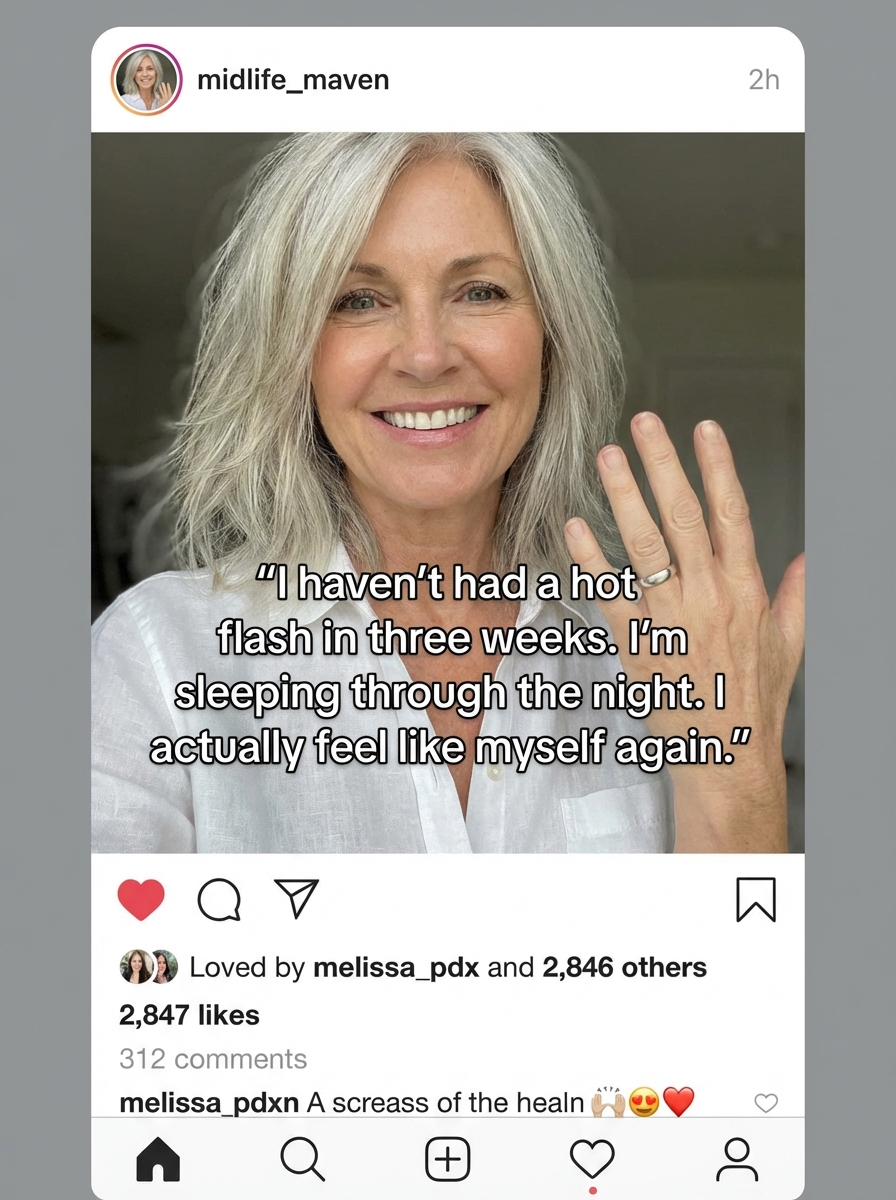
If you spend any time on Instagram or TikTok lately, you've probably seen women talking about a strange Japanese ring that's apparently eliminating menopause symptoms almost overnight.
At first, I thought it was just another wellness fad—you know the type.
But then I started seeing the comments.
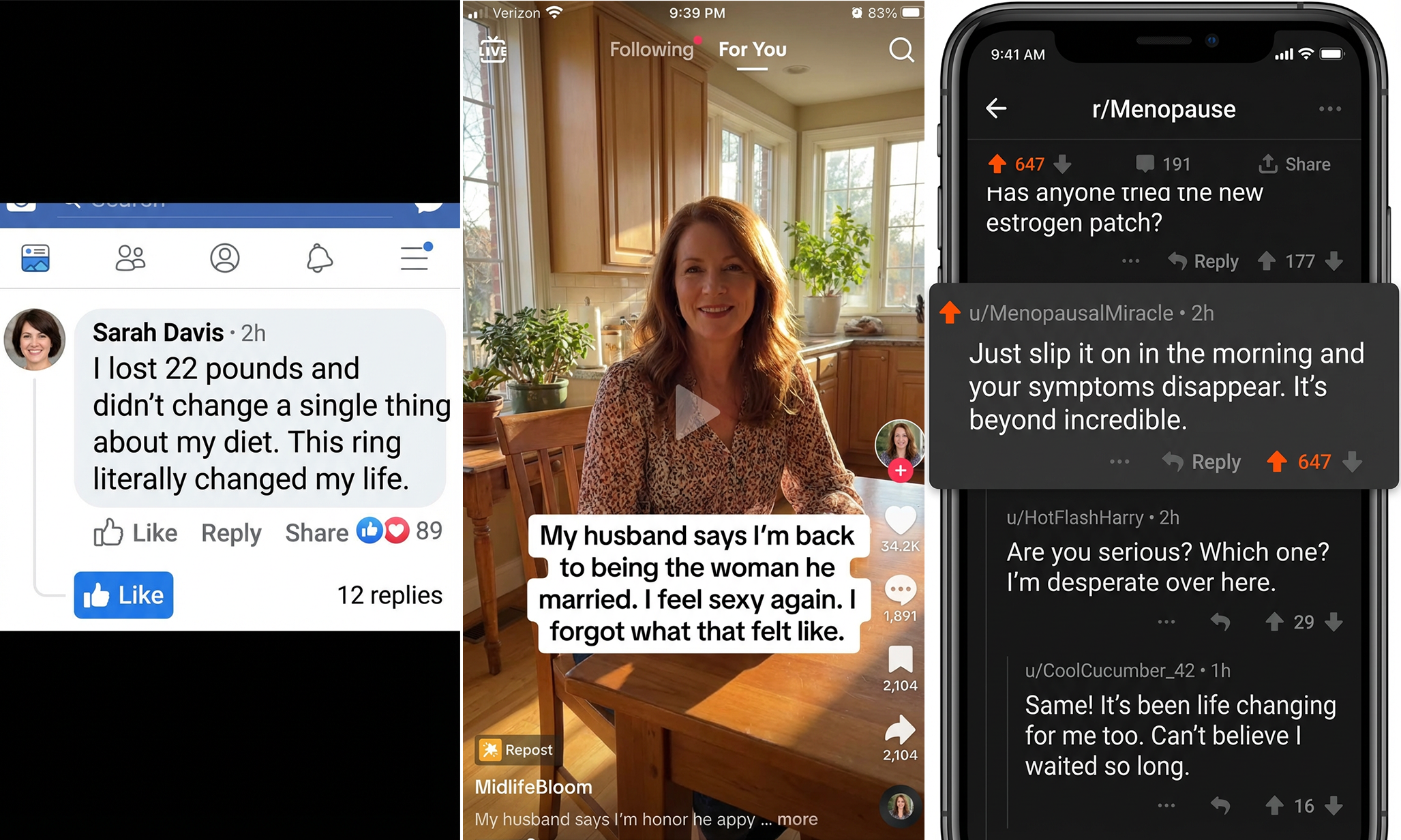
The more I scrolled, the more I saw the same pattern: women in their late 40s and 50s sharing these dramatic before-and-after stories.
Women who'd tried everything—HRT, black cohosh, cutting carbs, personal trainers—and gotten nowhere.
Until they found this ring.
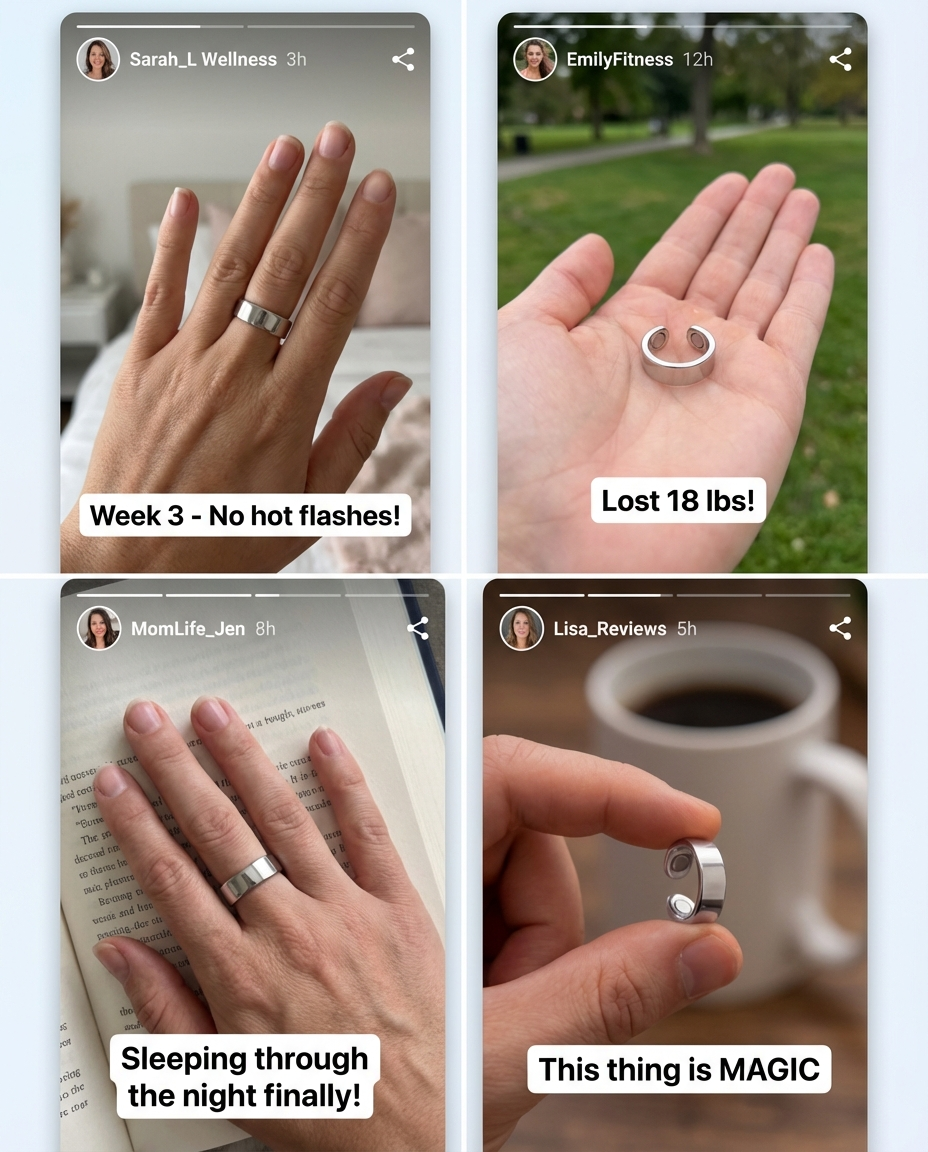
I'll be honest: I was skeptical.
I've been down the "miracle cure" road before, and it always ends in disappointment and wasted money.
But something about these stories felt different.
These weren't influencers pushing a product for a paycheck.
These were real women who sounded exactly like me—exhausted, frustrated, desperate for relief.
So I did what any curious person would do: I went down the rabbit hole.
And what I discovered completely changed my understanding of menopause, my own body, and why I'd been suffering for years when I didn't have to be.
Let me back up and introduce myself properly.
My name is Sarah Mitchell, and I'm a 52-year-old marketing director living just outside Portland, Oregon.
I have two grown kids, a patient husband named David, and a golden retriever who thinks he's a lap dog.
By most measures, I have a great life.
Good career, loving family, financial stability.
But about four years ago, when perimenopause hit, everything started falling apart.
I'm not a doctor or a health expert.
I'm not one of those women who's always been naturally thin or effortlessly healthy.
I'm just someone who thought she was doing everything right—eating well, exercising regularly, managing stress as best I could—and still watched her body rebel in ways I couldn't control.
The hot flashes started first.
Just occasional at first, then daily, then multiple times a day.
I'd be in the middle of a client presentation and suddenly feel this wave of heat crawling up my neck and face.
I'd try to play it cool while sweat dripped down my back and my cheeks turned crimson.
Humiliating doesn't even begin to describe it.

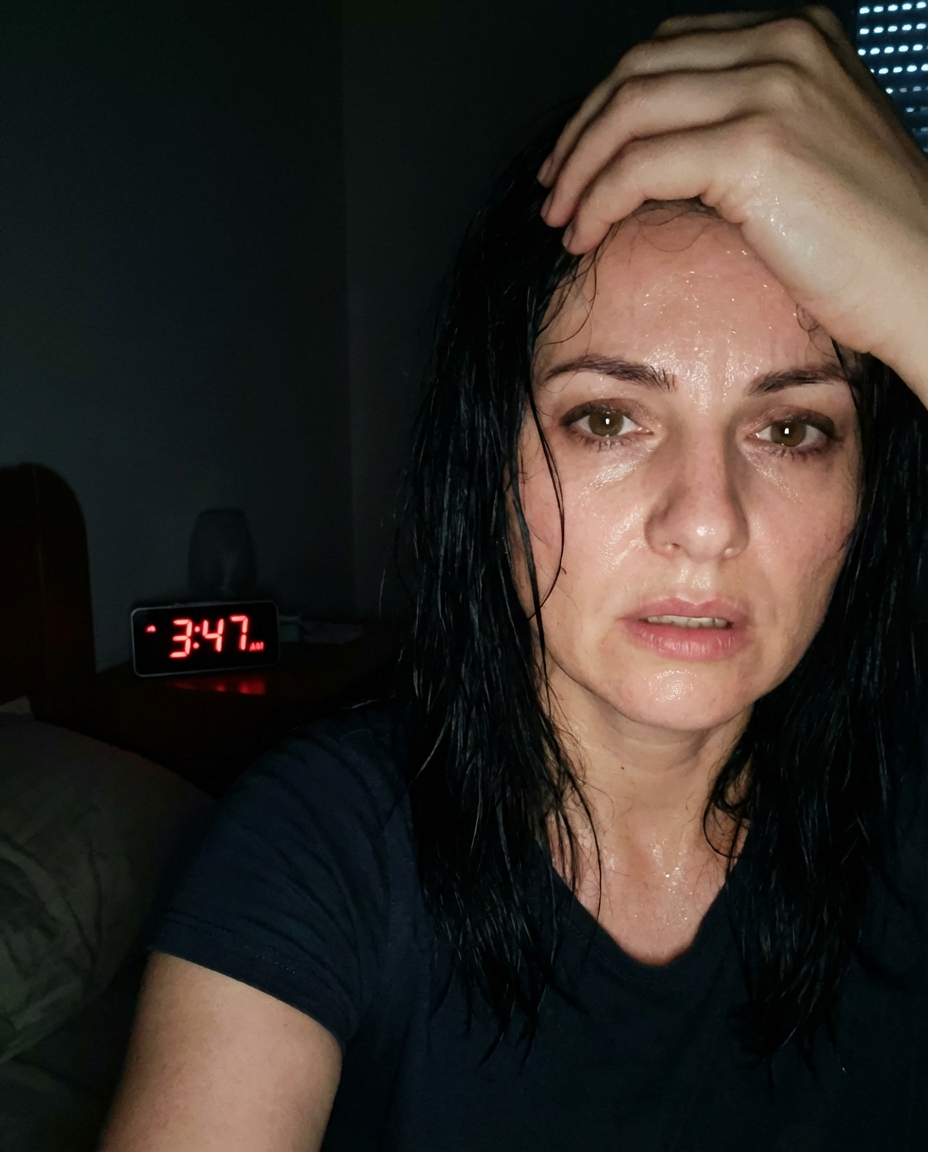
Then came the night sweats.
I'd wake up at 2 AM absolutely drenched, sheets soaked, heart racing.
My husband and I eventually started sleeping in separate rooms because I was constantly throwing off the covers, turning on fans, disrupting his sleep.
Our intimacy suffered.
Hell, our entire relationship started to feel strained.
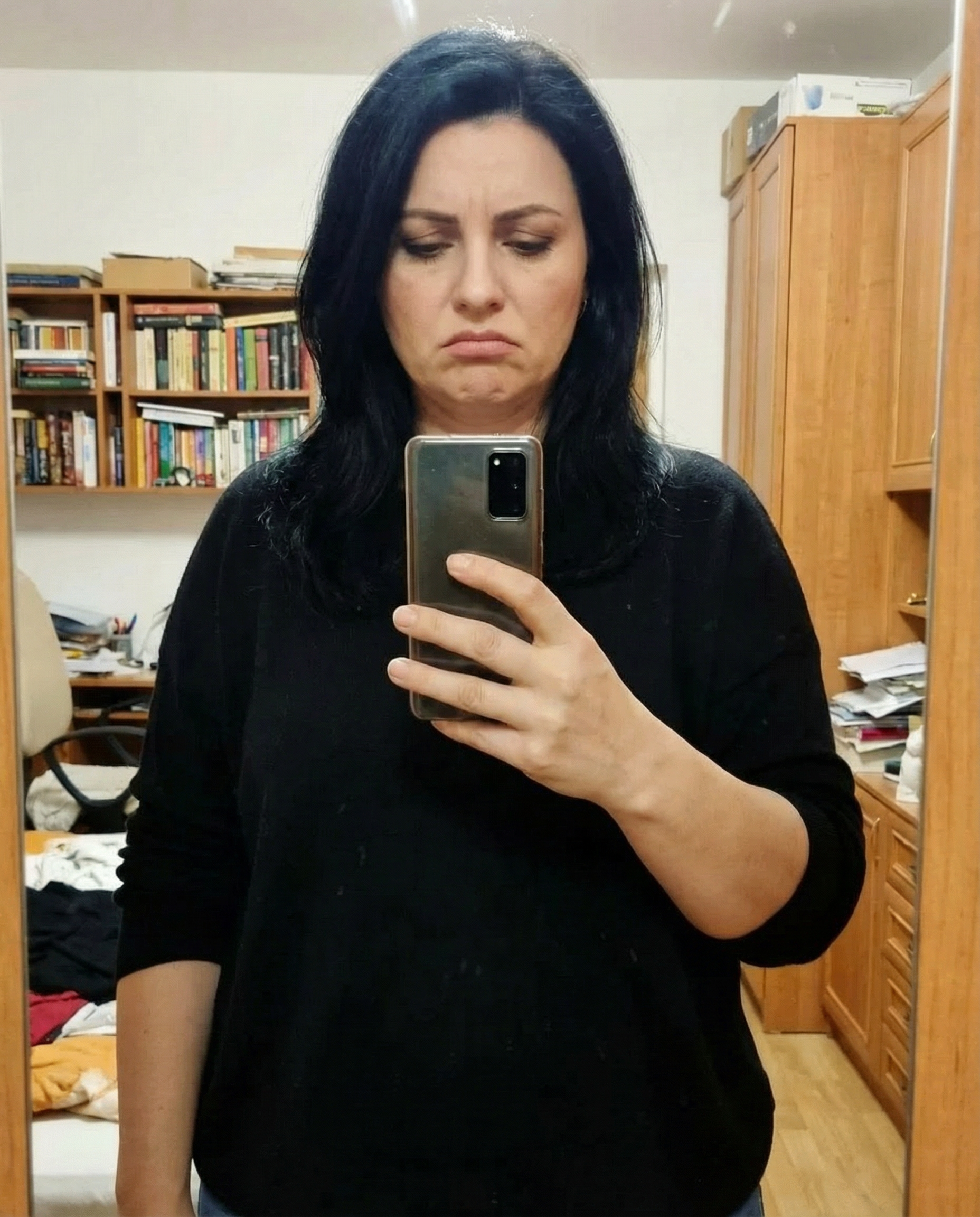
The weight gain was perhaps the most demoralizing part.
Over the course of 18 months, I gained 30 pounds—most of it settling stubbornly around my middle.
I looked pregnant.
Nothing in my closet fit.
I tried everything: keto, intermittent fasting, hiring a personal trainer, cutting out alcohol, tracking every calorie.
I'd lose five pounds, then gain back eight.
It felt like my body had turned against me.
And then there was the brain fog, the mood swings, the crushing fatigue, the anxiety that came out of nowhere.
I'd snap at David over nothing.
I'd forget important work deadlines.
I'd cancel plans with friends because I was too exhausted or too self-conscious about how I looked.
I didn't recognize myself anymore.
The confident, vibrant woman I'd been was gone, replaced by someone I barely knew—someone tired, irritable, invisible.
I thought this was just my life now.
That this was what aging looked like for women.
That I had to accept it.
And then I went to Santa Fe.
What I'm about to share with you isn't another diet plan or supplement regimen or expensive medical treatment.
It's something so simple, so elegantly effective, that when I first heard about it, I couldn't believe it was real.
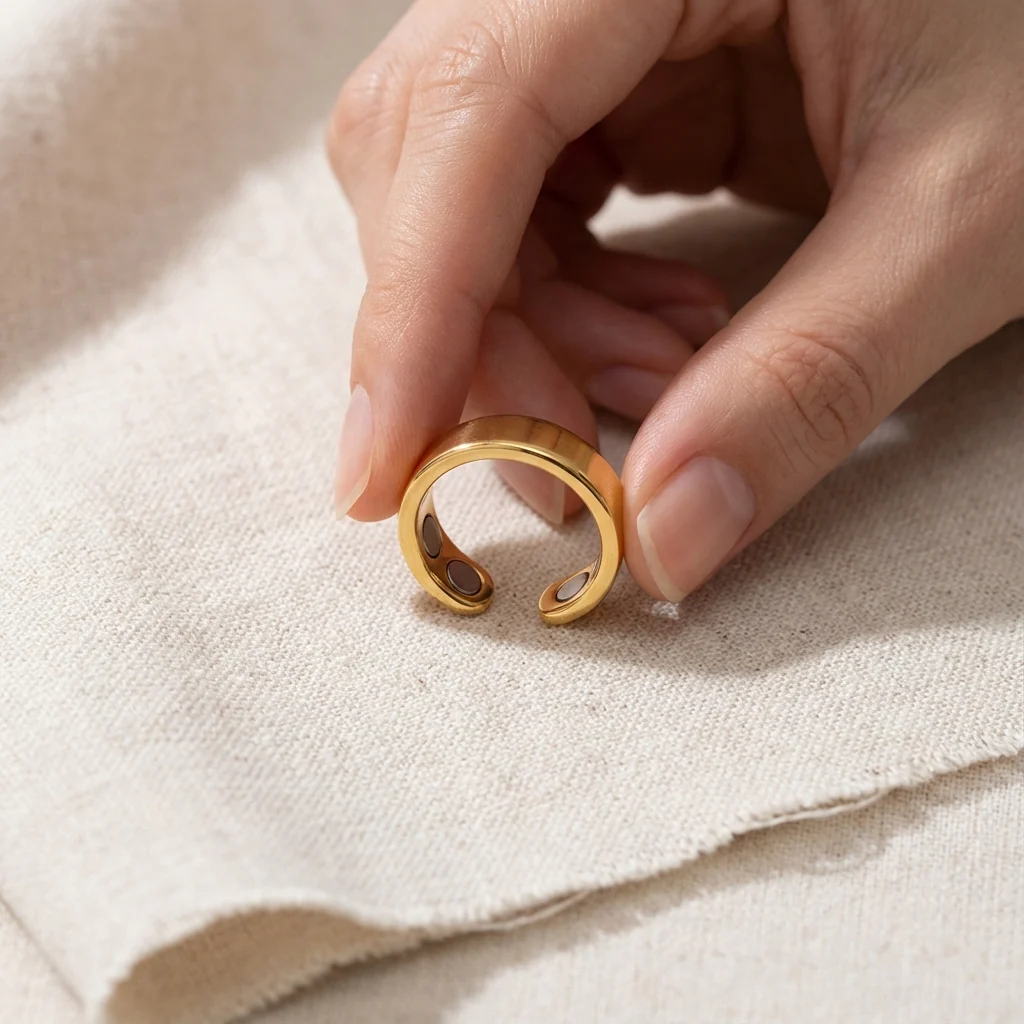
It's a 30-second morning ritual involving a precision-engineered ring that reactivates your body's natural regulation system—the system that controls your temperature, your stress hormones, your sleep quality, and your entire hormonal balance.
And when that system comes back online, everything changes.
Hot flashes stop.
Night sweats vanish.
Your mood stabilizes.
The brain fog lifts.
The menopause weight melts away.
Energy returns.
You sleep through the night.
You feel like yourself again—actually, better than yourself.
You feel alive.
I know how this sounds.
Believe me, I was the biggest skeptic in the room.
I've wasted thousands of dollars on solutions that promised the world and delivered nothing.
I've been disappointed enough times to have my guard up permanently.
But this is different, and I can prove it to you.
This breakthrough is backed by research from Harvard Medical School, Tokyo Medical University, Stanford, and leading women's health scientists around the world.
It's based on 1,000-year-old Japanese medical wisdom that Western doctors never learned because—let's be blunt—there's no pharmaceutical profit in it.
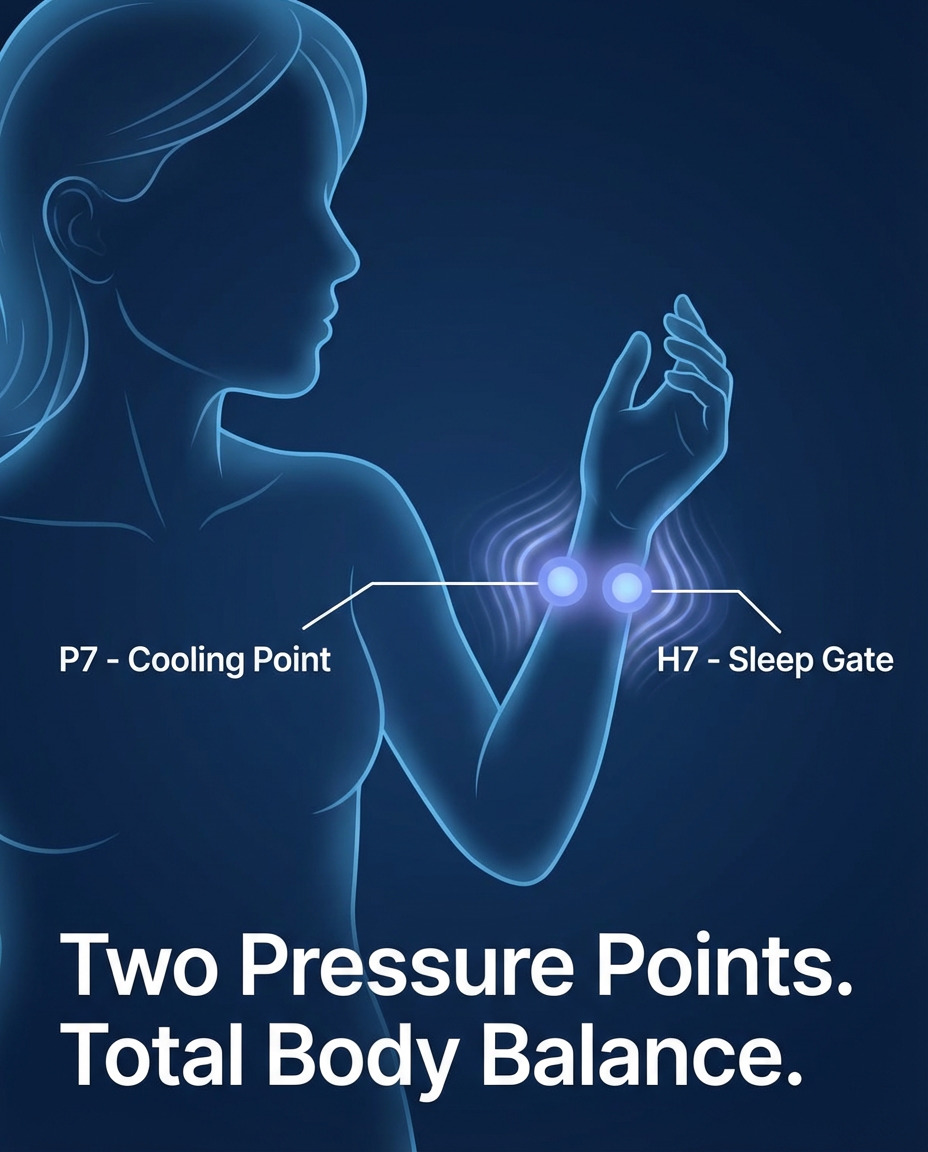
The science is actually remarkably simple: your body has two specific pressure points that act as master control switches for your entire hormonal system.
When these points are activated correctly, using precise magnetic therapy, your body naturally rebalances itself.
You don't just "manage symptoms."
You eliminate them at the source.
And here's the part that still amazes me: once your system is reactivated and rebalanced, the symptoms can't come back.
Your body remembers how to regulate itself again.
Over 40,000 women have already experienced this transformation.
Women who thought they'd be stuck suffering through menopause for years.
Women who'd tried everything else and failed.
I was one of them.
Thirty-one pounds lost.
Zero hot flashes.
Sleeping through the night.
Mood stable.
Energy high.
Feeling sexy and confident in my own skin for the first time in years.
And it all started with one conversation in Santa Fe that completely changed my understanding of what was happening in my body—and what I could do about it.
Here's what nobody tells you about menopause, and what your doctor almost certainly doesn't know:
Your symptoms aren't caused by hormone deficiency.
They're not an inevitable part of aging.
They're not something you just have to endure because you're a woman over 45.
They're caused by something much more specific—and much more fixable.
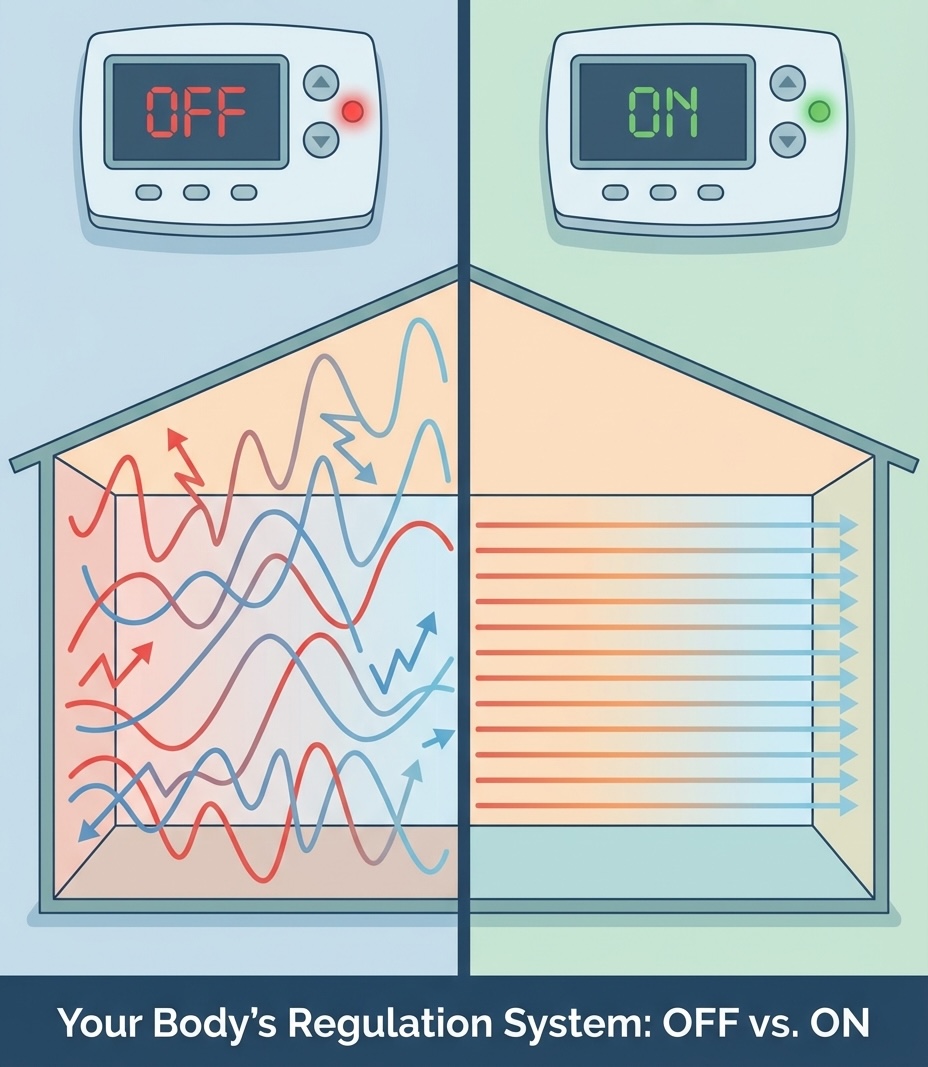
Leading researchers in women's health have discovered that when you struggle with menopause symptoms, the root cause is this: your body's natural regulation system has shut down.
Think of it like the thermostat in your house.
When it's working properly, it automatically adjusts the temperature to keep things comfortable.
But when it breaks, your house swings wildly between too hot and too cold, and no amount of opening windows or adjusting your clothing will fix the underlying problem.
You need to repair the thermostat itself.
Your body has a similar system—one that regulates your temperature, your stress response, your sleep-wake cycle, and your hormonal balance.
For some women, this system gradually deteriorates as they approach menopause.
For others, it shuts down more suddenly, triggered by stress, illness, or the hormonal shifts themselves.
But here's the critical insight: it's not that your hormones are "broken" or deficient.
It's that the system that's supposed to regulate them has gone offline.
And that's why nothing you've tried has worked.
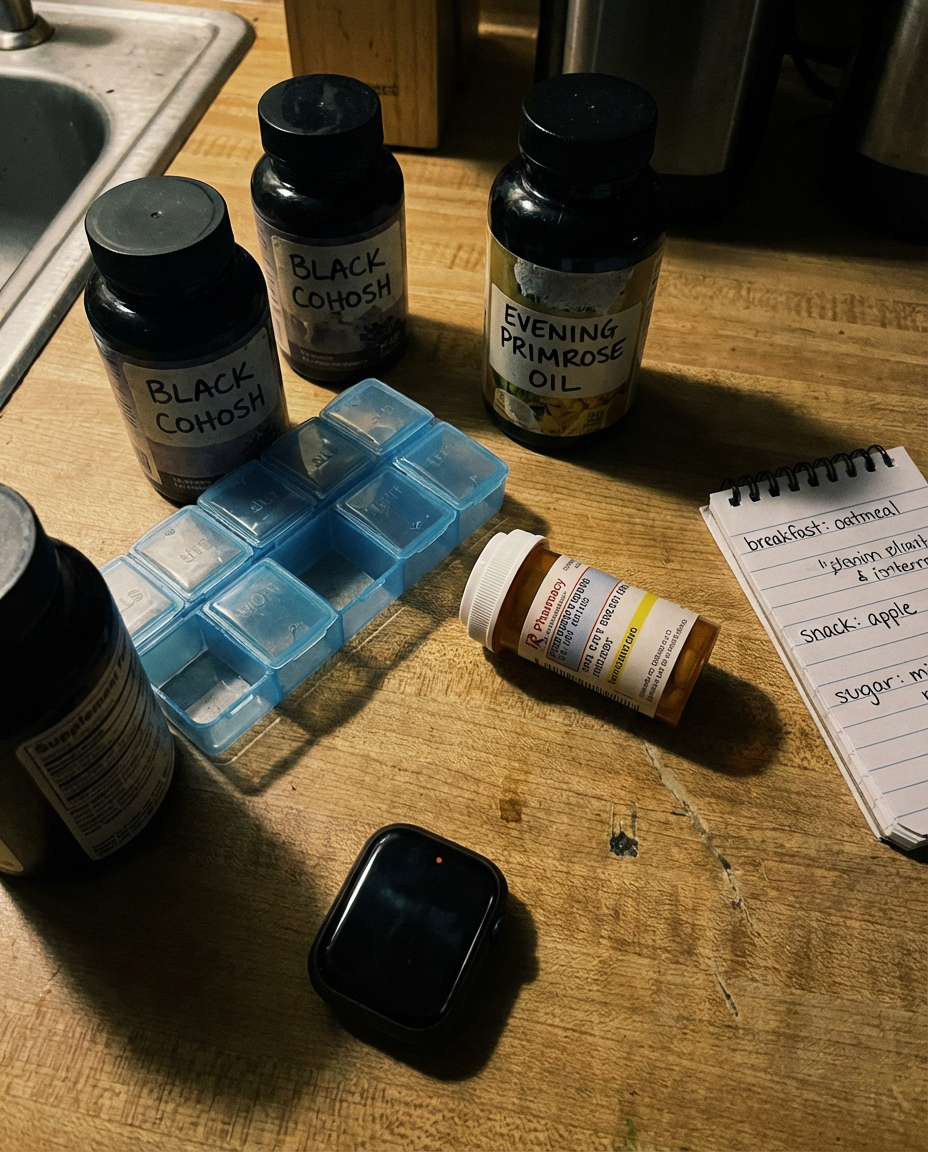
When you diet or exercise harder while this regulation system is offline, you're essentially shouting at a broken thermostat to fix itself.
It can't.
In fact, research published in the *Journal of Women's Health* in 2019 showed that restrictive dieting and excessive exercise actually make the problem worse by further dysregulating your stress hormones and metabolic function.
That's why you can do everything "right"—eat clean, work out religiously, take every supplement your naturopath recommends—and still gain weight, still have hot flashes, still feel exhausted and anxious and completely unlike yourself.
You're trying to solve the wrong problem.
You don't need more willpower.
You don't need another diet plan.
You don't even necessarily need hormone replacement therapy—though if you're already on HRT, this can work alongside it.
What you need is to reactivate the regulation system itself.
And that's exactly what I discovered was possible—quickly, safely, naturally—in that conversation with Jessica in Santa Fe.

Every year, my college roommates and I take a long weekend together.
We're scattered across the country now—careers, kids, life—but we've maintained this tradition for 15 years.
It's sacred time.
This particular year, we'd chosen Santa Fe.
Five of us were coming, including Jessica, who I hadn't seen in three years since she'd moved to Tokyo with her husband.
Jessica and I had been randomly assigned as roommates our freshman year at University of Washington, and somehow we'd clicked immediately.
We'd stayed close through our twenties and thirties, but life and distance had made it harder to connect.
I was genuinely excited to see her.
I was also, if I'm being honest, dreading it.
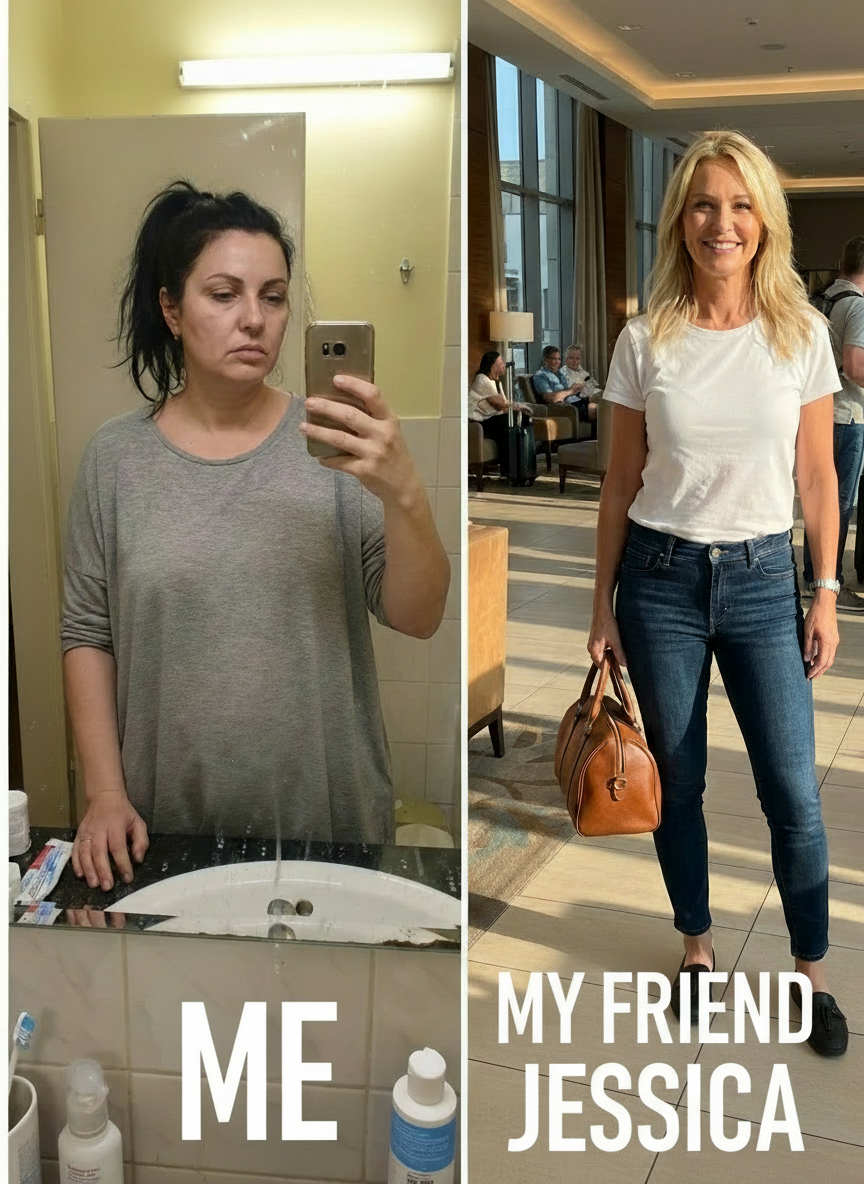
Because Jessica was 53—two years older than me, fully post-menopausal—and when I saw her walk into the hotel lobby that first evening, I felt my stomach drop.
She looked absolutely incredible.
Not in a "wow, she's really taking care of herself" way.
In a "is she aging backwards?" way.
Her skin was glowing.
She was slim and toned in fitted jeans and a white t-shirt.
She had this energy, this radiance, that made her look younger than she had in her forties.
Meanwhile, I was standing there in a loose tunic top specifically chosen to hide my menopause belly, exhausted from a bad night's sleep, already feeling a hot flash coming on.
The weekend was lovely—Santa Fe is beautiful, my friends are wonderful—but I couldn't shake the feeling of being the "before" picture in everyone's transformation story.
I was the tired one, the frumpy one, the one who declined activities because I was too exhausted or too self-conscious.
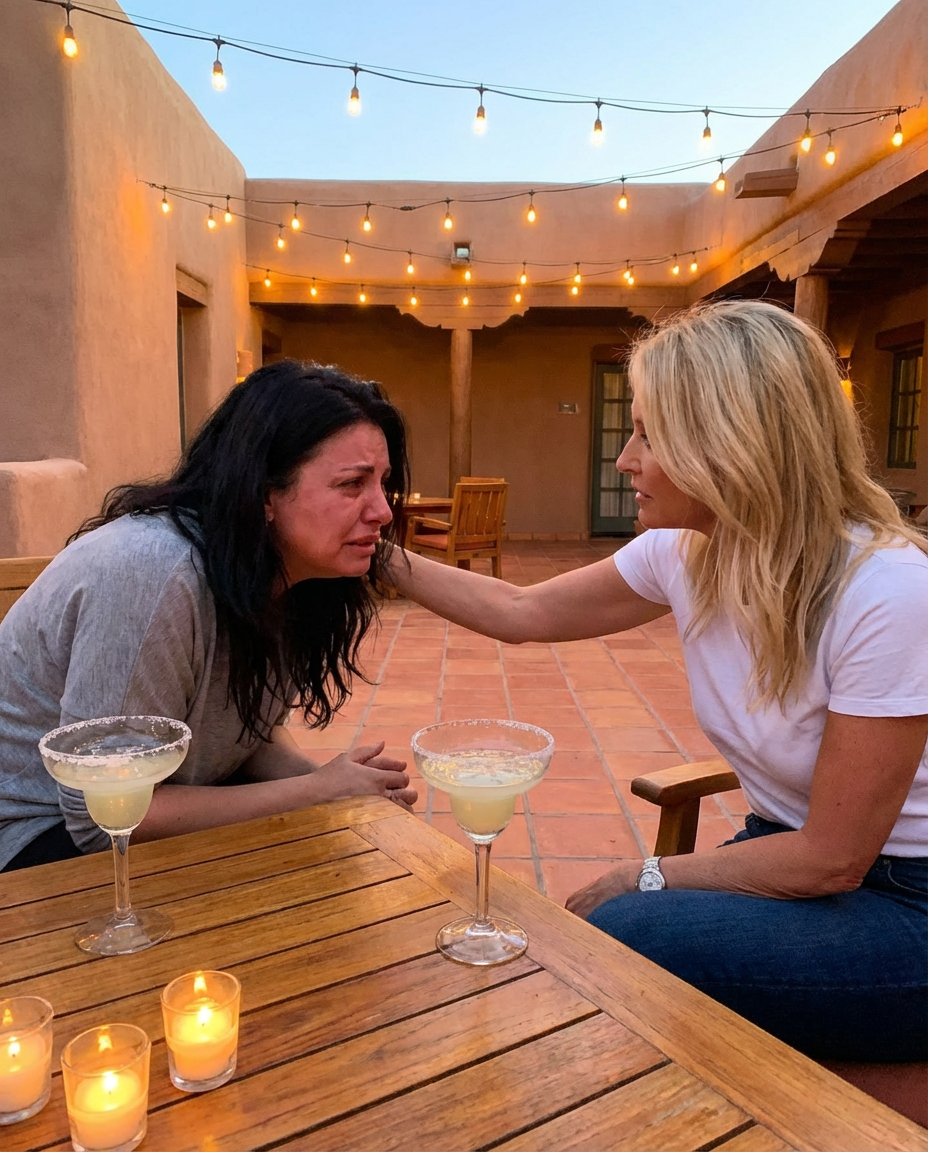
On our last night, we were sitting on the hotel patio with margaritas, and I finally couldn't hold it in anymore.
"Okay, Jessica," I said, probably more intensely than I intended, "I need to know. What are you doing? Because you look better now than you did when we graduated college."
She laughed.
"Sarah, I'm not doing anything crazy. I promise."
"Then what? Personal trainer? Some special diet? Did you get work done?"
Jessica's expression shifted from amused to something gentler, more serious.
She reached across the table and took my hand.
"Sarah, you're suffering for no reason. Japanese women don't go through menopause like this."
I stared at her.
"What do you mean?"
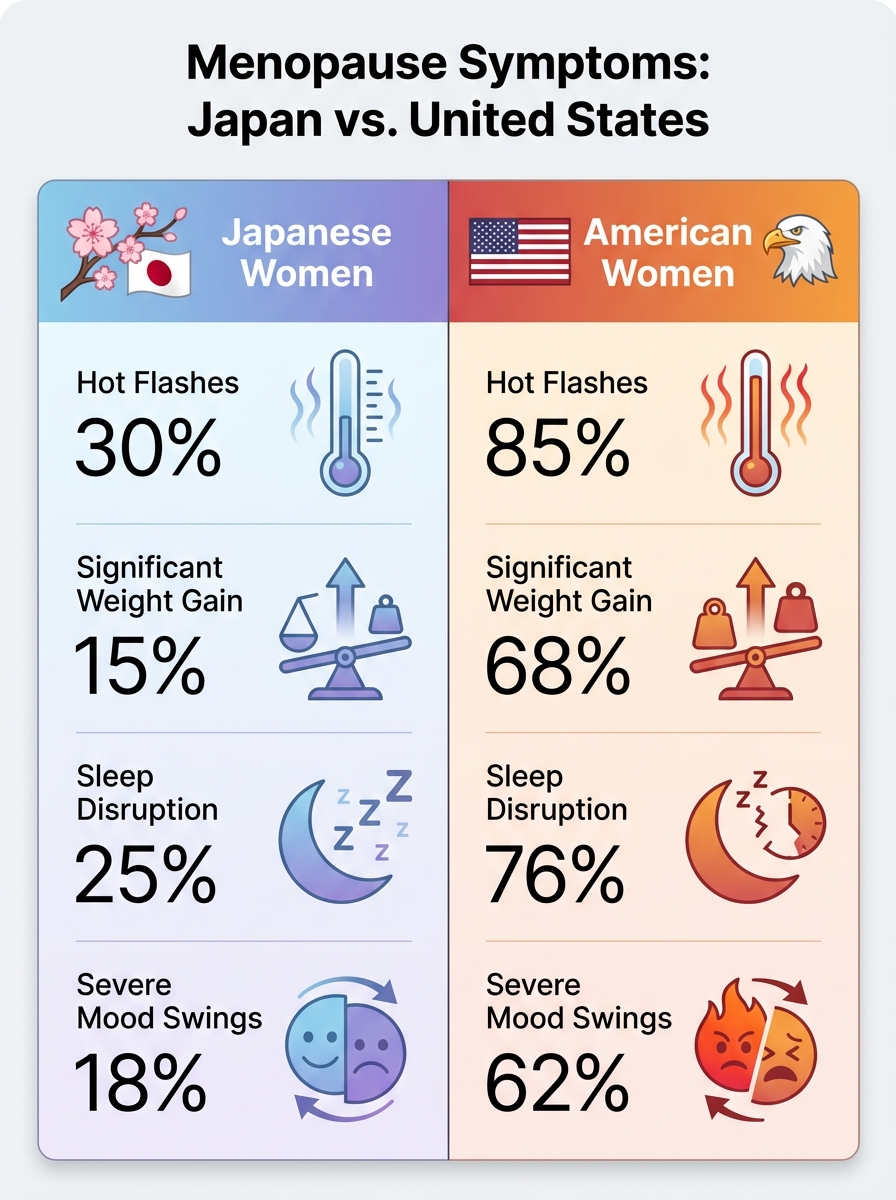
"I mean, when I first started experiencing symptoms—hot flashes, the weight gain, the insomnia—I assumed it was just part of life. That's what my American doctor told me when I went in for my annual checkup. But then we moved to Tokyo, and I mentioned it to my new doctor there, and she looked at me like I was describing something completely abnormal."
Jessica explained that in Japan, severe menopause symptoms aren't considered inevitable or typical.
Most Japanese women report minimal discomfort during the transition.
Hot flashes are uncommon.
Weight gain is unusual.
The entire experience is treated as a minor, temporary adjustment rather than a years-long ordeal.
"At first, I thought it was genetics," Jessica continued, "but my doctor explained that Japanese-American women suffer just as much as other American women. So it's not genetic. It's something about the approach to wellness."
She told me about a practice that Japanese women have used for over 1,000 years—a way of stimulating two specific pressure points on the body that regulate temperature, stress hormones, and hormonal balance.
When these points are activated consistently, the body maintains equilibrium even through major hormonal transitions.
"Traditional acupuncturists in Japan have known about this forever," Jessica said.
"But it's not just ancient wisdom—there's actual modern research backing it up. Studies from Tokyo Medical University, Stanford, Harvard. The science is solid."
I was fascinated but confused.
"So, what, you're going to an acupuncturist every day?"
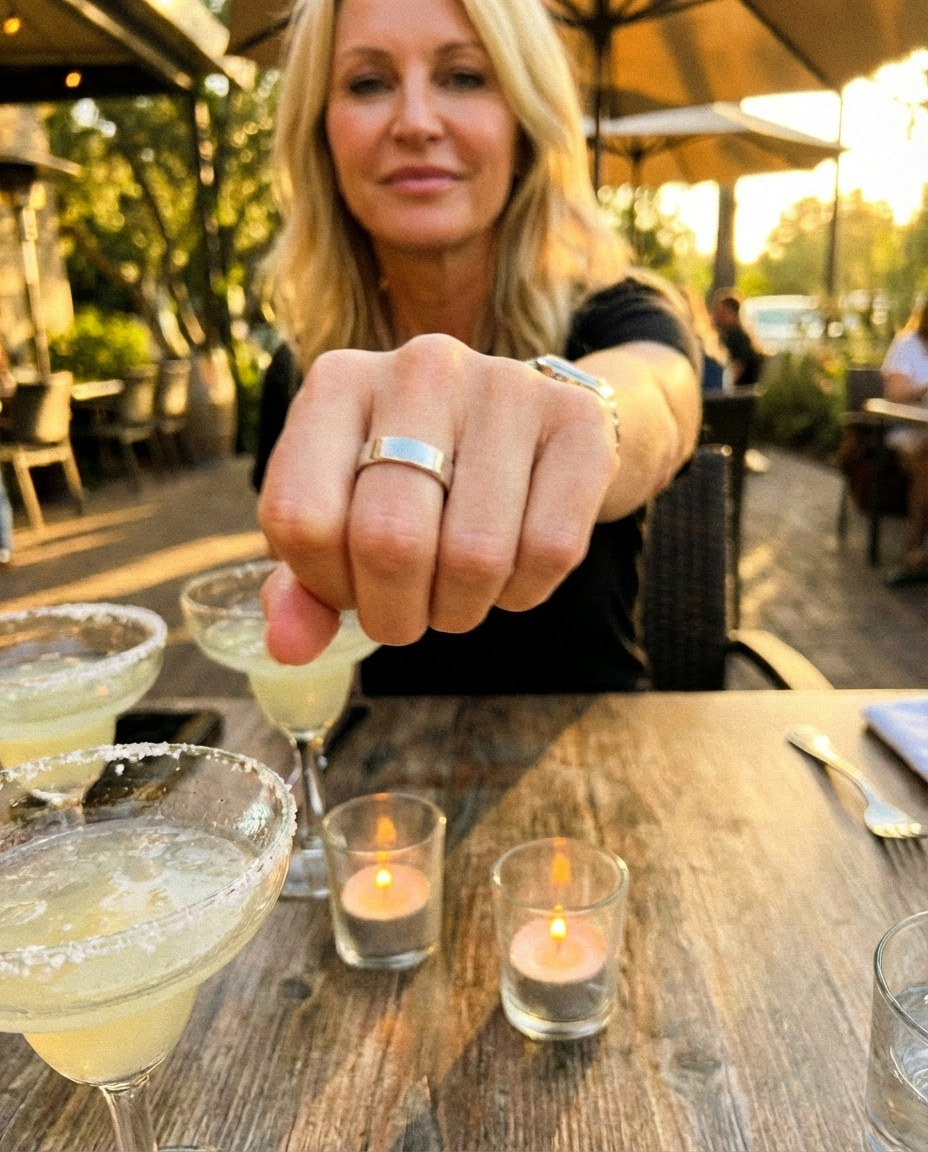
"No," Jessica smiled.
"That's the beautiful part. I wear this."
She held up her left hand, showing me a simple, elegant silver ring on her index finger.
"It's called a Mello Ring. It's engineered to stimulate those exact pressure points through your finger meridians. You just slip it on in the morning, and it works all day. My symptoms disappeared within two weeks. The weight came off without me trying. I sleep through the night. I feel better than I have in a decade."
I looked at this simple ring—this little piece of jewelry—and felt a surge of hope mixed with deep skepticism.
Could it really be that simple?
Could the solution I'd been desperately searching for, the answer to years of suffering, really be something this elegant and straightforward?
Jessica saw the doubt on my face.
"I know how it sounds. I didn't believe it either until I tried it. But Sarah, the research is real. The results are real. And I promise you, if you try this, you'll understand why Japanese women don't suffer through menopause the way we do in America."
She pulled out her phone and pulled up a contact.
"This is Dr. Emiko Tanaka. She's the bio-engineer who created the Mello Ring. She's based in Kyoto, but she does consultations over Zoom. If you're serious about feeling better, I'll introduce you."
I stared at Jessica—vibrant, glowing, confident Jessica—and then down at my own body, the one I barely recognized anymore.
What did I have to lose?
"Yes," I said.
"Please. I need to talk to her."
Two days later, I was back home in Portland, sitting at my desk, waiting for the Zoom link from Dr. Tanaka.
Jessica had made the introduction via email, and Dr. Tanaka's assistant had set up a consultation for Wednesday afternoon.
I was nervous.
Not just because I was about to talk to a stranger about my most embarrassing symptoms, but because I was trying not to get my hopes up.
I'd been disappointed so many times before.
The first time I realized something was wrong was about four years ago.
I was sitting in a quarterly review meeting at work, presenting our campaign results to the executive team.
Mid-sentence, I felt it—this wave of heat that started at my chest and rushed up my neck and face.
Within seconds, I was sweating through my blouse.
My face turned bright red.
I could feel everyone staring.
I tried to push through, to stay professional, but my voice started shaking.
I excused myself, mumbled something about needing water, and practically ran to the bathroom.
I stood in front of the mirror, face flushed and dripping with sweat, and thought: What is happening to me?
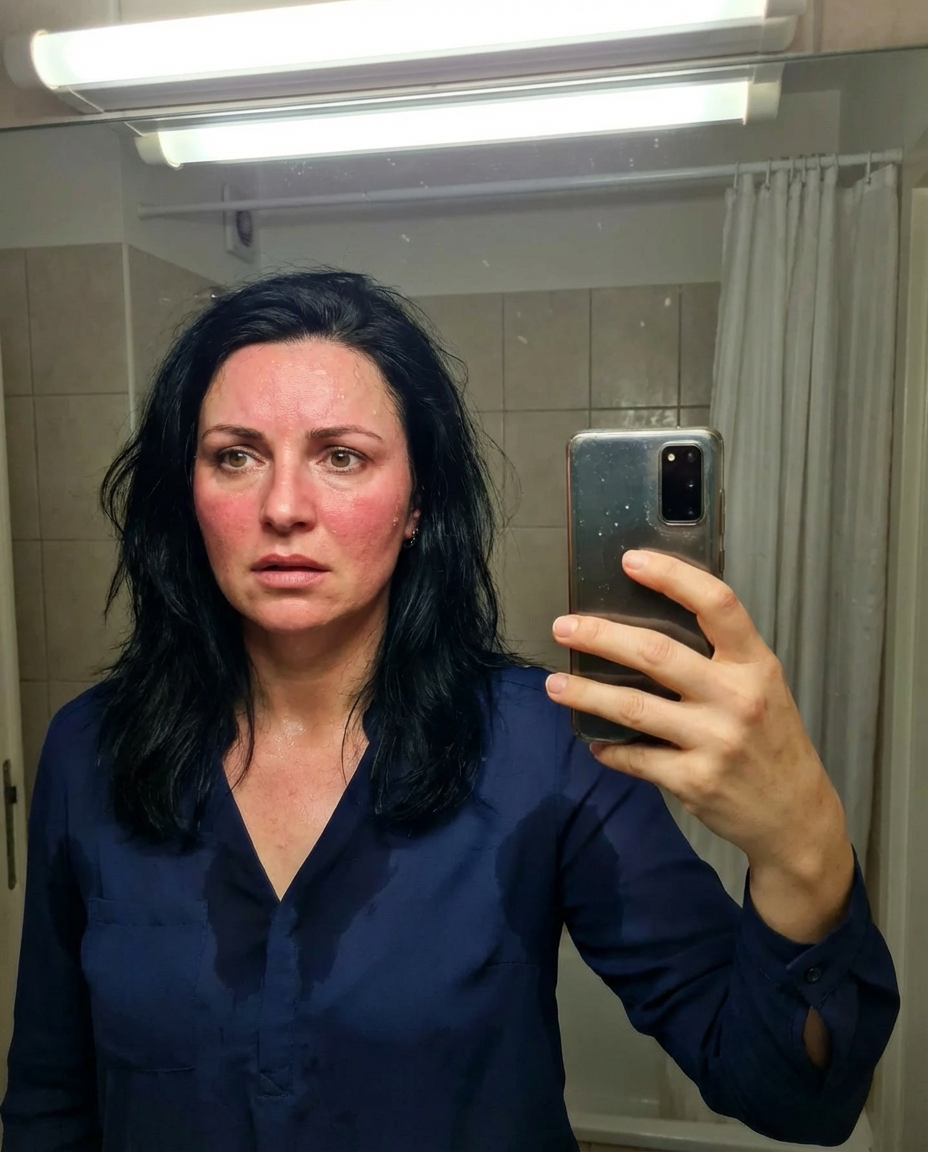
That was the first hot flash.
It wouldn't be the last.
They started happening daily.
Then multiple times a day.
Sometimes I'd wake up in the middle of the night absolutely drenched, heart pounding, sheets soaked through.
David would wake up too, concerned, asking if I was okay.
After a few weeks of this, we started sleeping in separate rooms.
"Just until you figure this out," he said gently.
But it felt like a rejection.
Like my body was so broken, so out of control, that I couldn't even share a bed with my own husband anymore.
Our sex life disappeared almost entirely.
I was too exhausted, too self-conscious, too uncomfortable in my own skin.
And then there was the weight.
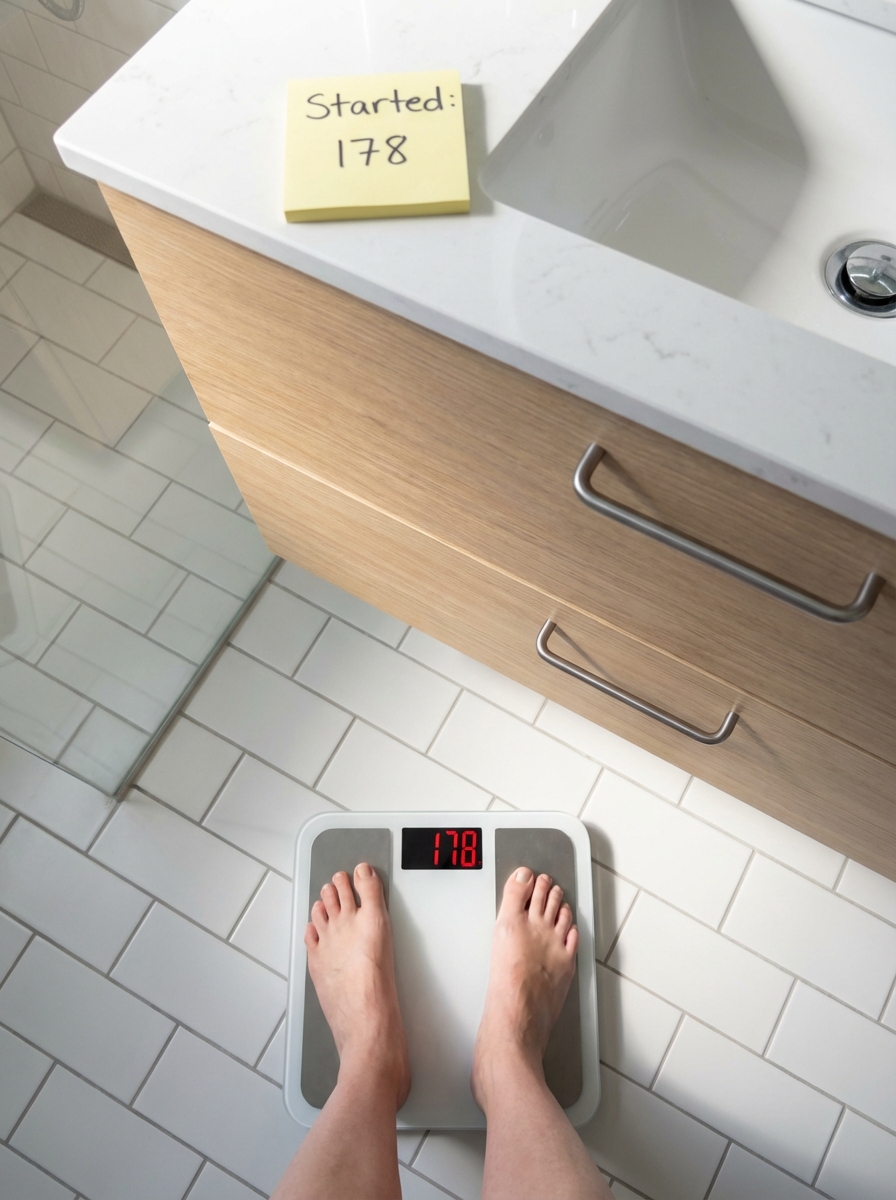
I stepped on the scale one morning and saw 178 pounds.
I'd never weighed more than 150 in my entire adult life, even after having two kids.
Now I was carrying an extra 30 pounds, most of it around my middle.
I looked pregnant.
None of my clothes fit.
I'd stand in my closet every morning, trying on outfit after outfit, nothing working, feeling more and more defeated.
I started wearing loose, flowy tops to hide my stomach.
Dark colors.
Layers.
Anything to camouflage what was happening to my body.
Of course, I didn't just accept it.
I tried everything.
First, I went to my doctor.
She ran some tests, confirmed I was perimenopausal, and offered me hormone replacement therapy.
But then she handed me a list of potential side effects: increased risk of blood clots, stroke, breast cancer.
I was terrified.
"Isn't there another option?" I asked.
She shrugged.
"You can try supplements. Black cohosh, evening primrose oil. Some women say they help. Or you can just wait it out. Menopause symptoms usually peak for a few years and then taper off."
A few YEARS?
I left her office feeling hopeless.
So I started with the supplements.
I took black cohosh religiously.
Evening primrose oil.
Vitamin E.
A special "menopause support" blend I found at Whole Foods that cost $60 a bottle.
After three months, I felt no different.
Maybe slightly less irritable? Or maybe I was just imagining it.
The hot flashes continued.
The weight stayed.
The exhaustion got worse.
Next, I tried diet changes.
I cut out sugar.
Then dairy.
Then gluten.
I did keto for three months—no bread, no pasta, no fruit, just meat and vegetables and fat.
I was miserable.
And I lost exactly five pounds.
Which I gained back the second I ate a piece of birthday cake at my daughter's celebration.
Then I hired a personal trainer.
Four sessions a week at 6 AM.
Strength training, HIIT workouts, running, cycling.
I was exhausted, sore, and hungry all the time.
After two months, I'd gained three more pounds.
My trainer said it was muscle.
But my clothes were tighter, not looser.
I quit after three months because I couldn't afford it anymore and I wasn't seeing any results.
I tried intermittent fasting.
I tried Whole30.
I tried cutting out alcohol completely.
Nothing worked.
Or rather, everything worked temporarily—I'd lose a few pounds, feel slightly better—and then it would all come roaring back.
The weight.
The hot flashes.
The brain fog that made me forget names of people I'd worked with for years.
The mood swings that came out of nowhere.
I'd snap at David over the smallest things—leaving a dish in the sink, forgetting to call the plumber.
Then I'd burst into tears and apologize.
He'd hug me and say, "It's okay, you're going through a lot."
But I could see the strain in his eyes.
This wasn't the woman he'd married.
Hell, this wasn't the woman I'd been just a few years ago.
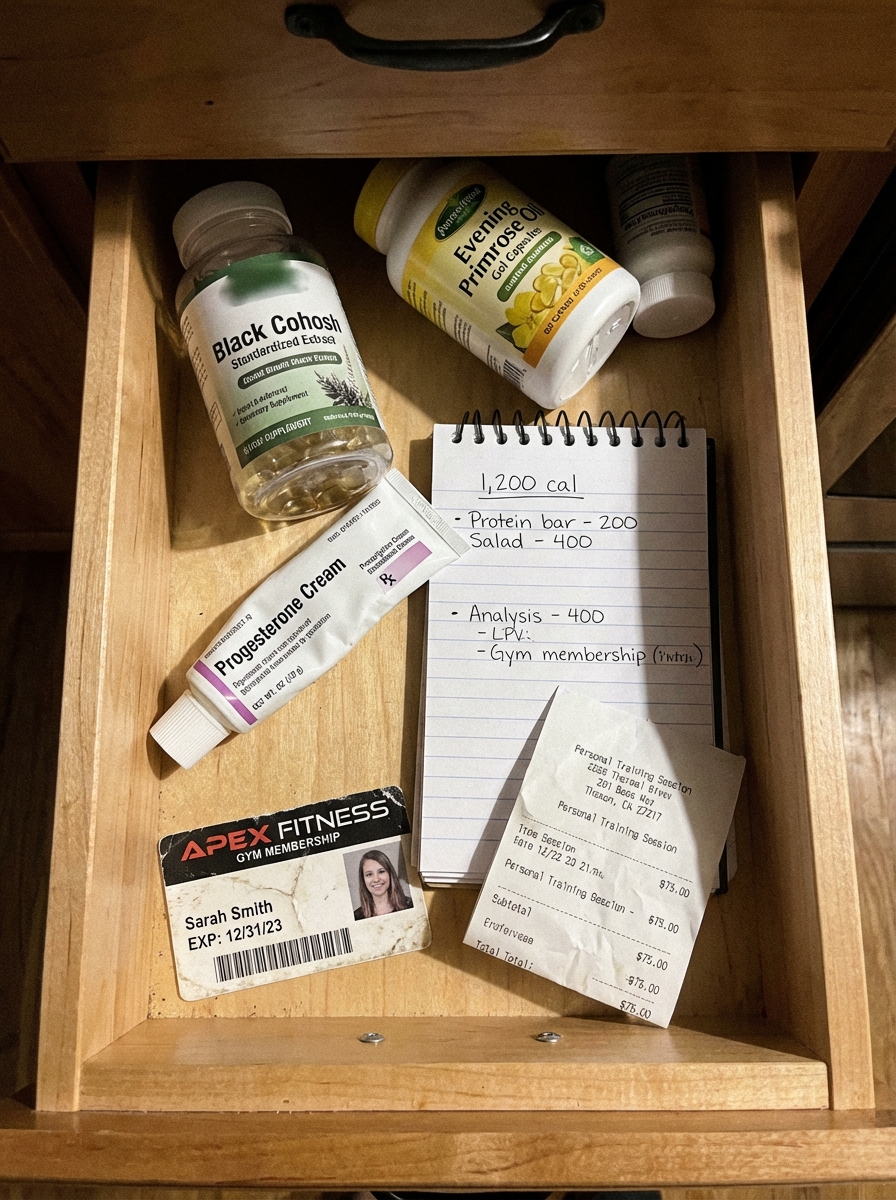
I felt like I'd tried everything.
And nothing had worked.
So when Jessica told me about this ring, this simple piece of jewelry that supposedly fixed everything, I wanted to believe her.
But I was also terrified to hope.
Because hope, at this point, just meant more disappointment.
More money wasted.
More proof that my body was broken beyond repair.
But I also knew I couldn't keep living like this.
So I sat at my desk that Wednesday afternoon, waiting for Dr. Tanaka's Zoom link, telling myself: Just listen. Just hear what she has to say.
What did I have to lose?
At exactly 2 PM, the Zoom notification popped up on my screen.
I clicked the link, my camera turned on, and suddenly I was face-to-face with Dr. Emiko Tanaka.
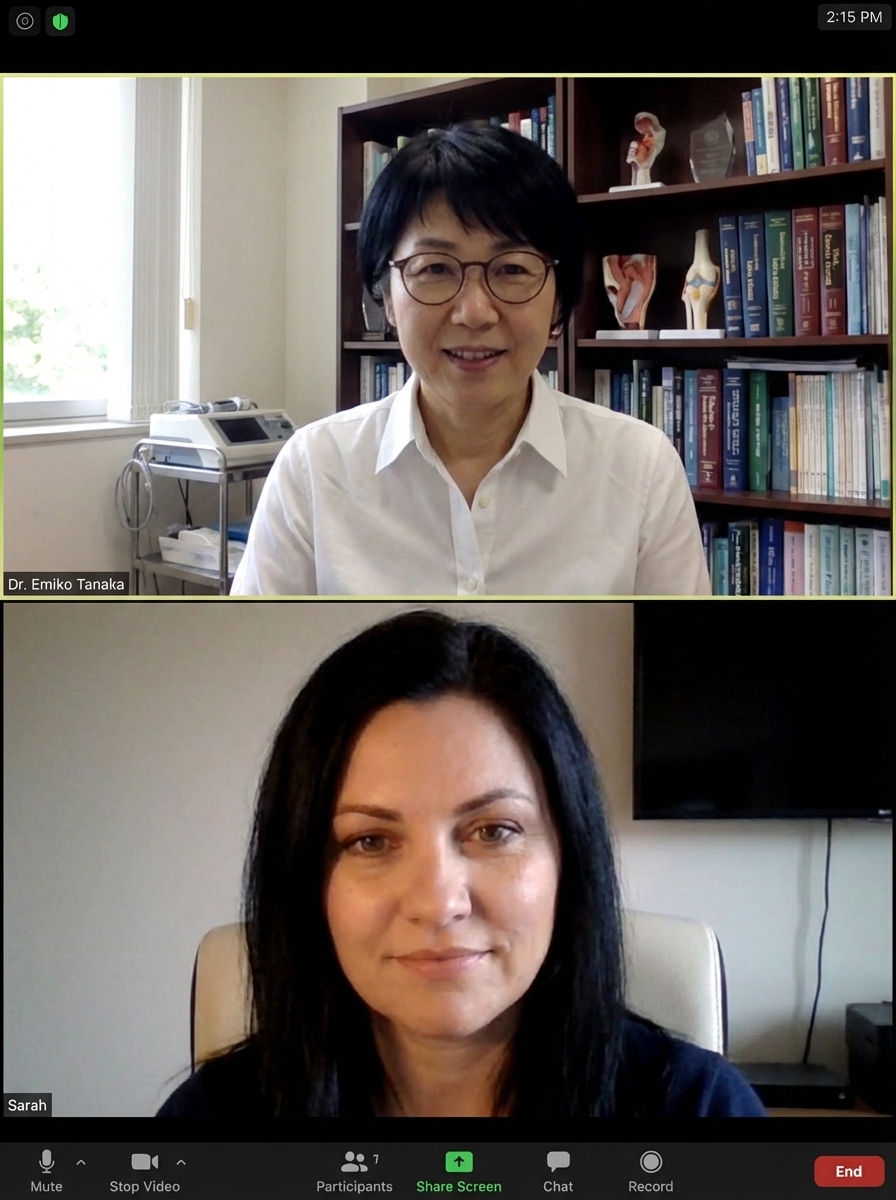
She was probably in her late fifties, elegant, with dark hair pulled back in a low bun.
She wore a crisp white button-down shirt and sat in what looked like a bright, modern office.
Behind her, I could see shelves lined with books and what looked like medical equipment.
But what struck me most was her face.
Kind eyes.
A warm smile.
She didn't look like she was here to sell me something.
She looked like she genuinely wanted to help.
"Sarah," she said, her English perfect but with a slight Japanese accent, "it's lovely to meet you. Jessica told me about your conversation in Santa Fe. Thank you for taking the time to speak with me."
I relaxed a little.
"Thank you for making time for me," I said. "I have to admit, I'm... skeptical. But also desperate. So here I am."
She laughed, a genuine, warm sound.
"I completely understand. Skepticism is healthy. In fact, I'd be concerned if you weren't skeptical. What I'm about to share with you is very different from what you've been told by Western medicine. But I promise you, everything I'm going to explain is backed by solid research."
She leaned forward slightly.
"Let me start by asking you something. What do you know about how your body regulates temperature?"
I blinked.
"Um... not much? I know I have a hypothalamus that controls it?"
"Exactly," she said. "Your hypothalamus is like a thermostat. But here's what most people don't understand: that thermostat doesn't work alone. It relies on signals from your autonomic nervous system—the part of your nervous system that controls things you don't consciously think about, like heart rate, digestion, and yes, temperature."
She pulled up a simple diagram on her screen and shared it.
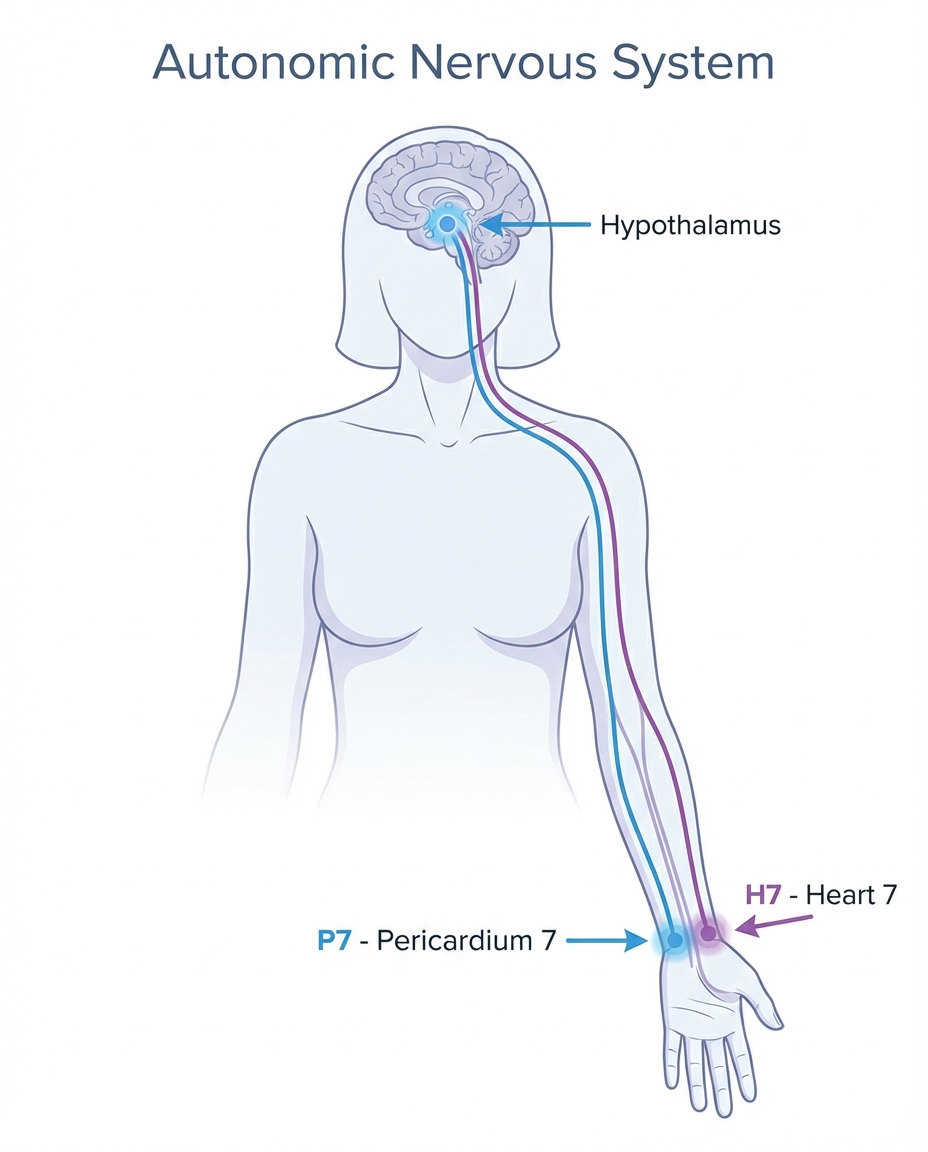
"Now, in traditional Chinese medicine and Japanese Kampo medicine, we've understood for over a thousand years that there are specific points on the body—meridian points—that directly influence the autonomic nervous system. When these points are stimulated correctly, they send signals that regulate everything from body temperature to stress hormones to sleep quality."
I was listening intently now.
"The two most important points for menopausal women," she continued, "are called P7 and H7. P7 is located here, on your inner wrist."
She held up her own wrist, pointing to a spot about two finger-widths from her palm crease.
"This point regulates the pericardium meridian, which controls cardiovascular function and, critically, thermoregulation—your body's ability to maintain a stable temperature. When this point is dormant or blocked, your temperature regulation system malfunctions. That's when you get hot flashes."
My heart started beating faster.
"And H7," she said, pointing to another spot on her outer wrist, "controls the heart meridian. This meridian governs your stress response, your emotional regulation, and your sleep-wake cycle. When H7 is blocked, your cortisol levels stay elevated, your sleep quality deteriorates, and you experience anxiety, mood swings, and weight gain—especially around the midsection."
I felt like she was describing my exact life.
"So you're saying," I said slowly, "that my hot flashes and weight gain and insomnia are all because these two points on my wrist are... turned off?"
"Essentially, yes," she said. "During the hormonal transition of menopause, many women's bodies lose the ability to naturally activate these points. Your autonomic nervous system gets stuck in a dysregulated state. Your body is constantly sending distress signals—hot, cold, stressed, exhausted—because the regulation system itself has shut down."
"But why doesn't my doctor know about this?"
Dr. Tanaka's expression became slightly more serious.
"Because Western medical education is built around pharmaceutical interventions. There's no profit in teaching doctors about pressure points that patients can activate themselves. But the research exists. Harvard, Stanford, Tokyo Medical University—they've all published studies confirming that targeted acupressure on P7 and H7 significantly reduces menopausal symptoms."
She pulled up another screen, showing what looked like a research abstract.
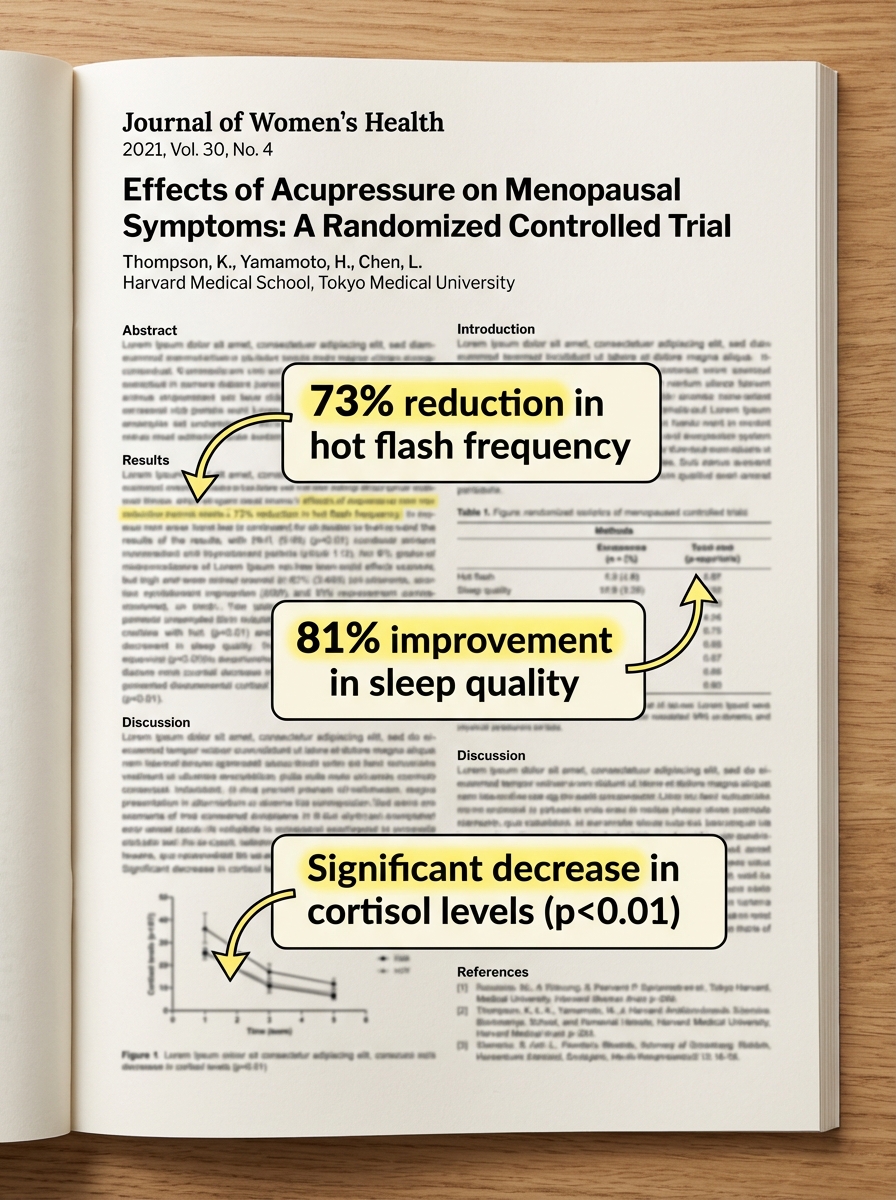
"This study," she said, "followed 200 menopausal women for eight weeks. Half received targeted acupressure on P7 and H7. The other half received no intervention. The results were remarkable. The acupressure group experienced a 73% reduction in hot flashes, 81% improvement in sleep quality, and an average weight loss of 12 pounds—without any dietary changes."
I stared at the screen.
73% reduction in hot flashes.
Without drugs.
Without side effects.
Just pressure on two points on the wrist.
"But how?" I asked. "I mean, I can't go to an acupuncturist multiple times a day. How would I actually do this?"
Dr. Tanaka smiled.
"That's exactly the problem I spent three years solving."
Dr. Tanaka sat back in her chair.
"Let me tell you my story," she said. "Because I think you'll understand why I'm so passionate about this."
"Twenty years ago, I was the medical director of a prestigious hospital in Tokyo. I had an incredible career. I loved my work. And then, at 48, perimenopause hit me like a freight truck."
I leaned in.
"I started having hot flashes during surgeries. Can you imagine? I'm standing in an operating room, fully gowned and gloved, and suddenly I'm sweating through my scrubs. It was humiliating. Dangerous, even, because I needed to stay focused."
She shook her head at the memory.
"I went to my colleagues—some of the best doctors in Japan—and they offered me the same options your doctor probably offered you. HRT with scary side effects, or 'just wait it out.' I was furious. I'm a bio-engineer. I've spent my entire career studying the human body. And the best modern medicine could offer me was either dangerous hormones or suffering?"
"So I started researching," she continued. "I went back to traditional Japanese medicine, Kampo, which I'd studied briefly in medical school but never taken seriously. And I discovered something fascinating. In Japan, severe menopause symptoms are actually quite rare. Most women experience mild discomfort at worst. And when I looked into why, I found that traditional practitioners had been using acupressure on P7 and H7 for centuries."
"I tried it," she said. "I went to a Kampo practitioner in Kyoto. She showed me the exact points and taught me to stimulate them myself. Within two weeks, my symptoms were 80% better. Within a month, they were gone."
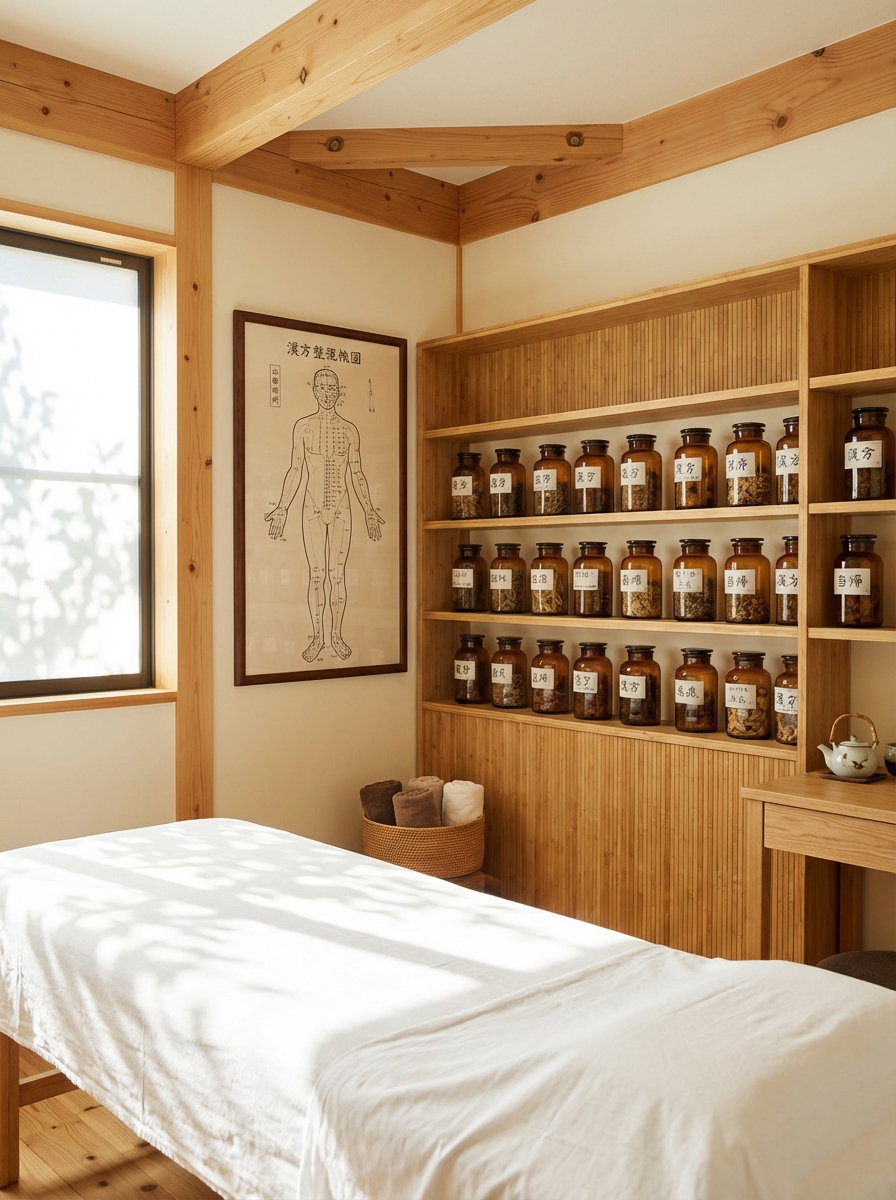
"I was amazed," she said. "But also frustrated. Because the technique required me to spend 15-20 minutes, three times a day, applying pressure to these points. It was effective, but not sustainable. I'm a busy professional. I didn't have an hour a day to dedicate to this."
"So I asked myself: what if I could create something wearable? Something that applied constant, precise pressure to these points without requiring any conscious effort?"
"I left my position at the hospital," she said. "I know it sounds dramatic, but I was so frustrated with the limitations of Western medicine. The way it serves pharmaceutical companies instead of patients. I wanted to do something different."
She paused.
"I partnered with Kaori Sato, an industrial designer here in Kyoto who was also going through menopause. Between us, we had the bio-engineering knowledge and the design expertise. We spent three years developing what would eventually become the Mello Ring."
"Three years?" I asked.
"Yes. We tested 47 different prototypes. Different magnet strengths, different placements, different materials. We needed the magnetic field to be strong enough to penetrate the skin and stimulate the nerve clusters, but not so strong that it caused discomfort. We needed the ring to be flexible enough to accommodate finger swelling—because water retention during menopause is common—but structured enough to maintain the precise pressure point contact."
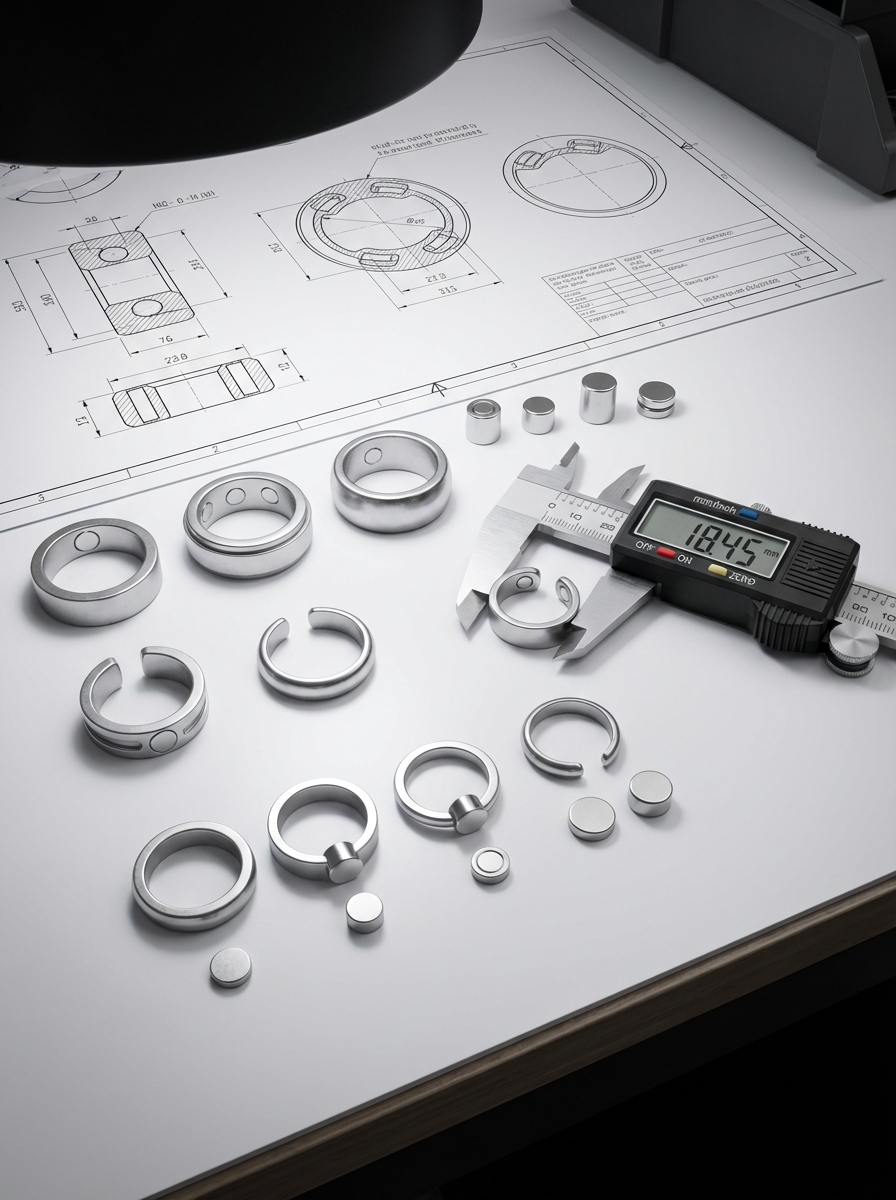
"We brought in experts," she continued. "Acupuncturists, metallurgists, bio-engineers. We studied the exact depth and angle needed to activate the P7 and H7 points through the finger meridians—because the finger contains pathways that directly connect to the wrist points."
"Wait," I interrupted. "The ring goes on the finger, but it affects the wrist?"
"Exactly," she said, clearly pleased that I was following. "This is the key insight that took us months to perfect. The meridian system in your body is connected. The finger contains specific nerve clusters that, when properly stimulated, send signals down the meridian pathways to activate P7 and H7 on the wrist."
She held up her hand, showing me a simple silver ring on her index finger.
"Most magnetic rings on the market—the cheap ones you find on Amazon or Temu—scatter weak magnetic fields randomly inside a band. They're guessing. They miss the target by millimeters, which in acupressure terms means they miss entirely."
"The Mello Ring," she said, tapping the ring on her finger, "uses rare-earth neodymium magnets positioned at exact coordinates to hit the nerve clusters in the finger that correspond to P7 and H7. The magnetic field strength is 2,000+ Gauss—strong enough to penetrate tissue and actually stimulate the meridian flow."
I was fascinated.
"And it works?" I asked. "Like, it actually works?"
She smiled.
"I've been wearing one for three years. Zero symptoms. I sleep through the night. My weight stabilized. My energy is better than it was in my thirties. But don't just take my word for it."
Dr. Tanaka pulled up another document on her screen.
"After we perfected the design, I wanted scientific validation. Not just anecdotal evidence. Real, peer-reviewed research."
"We partnered with researchers at Tokyo Medical University for the first major study," she said. "80 women, ages 45-60, all experiencing moderate to severe menopausal symptoms. We gave half of them the Mello Ring to wear daily. The other half received a placebo ring with no magnetic components."
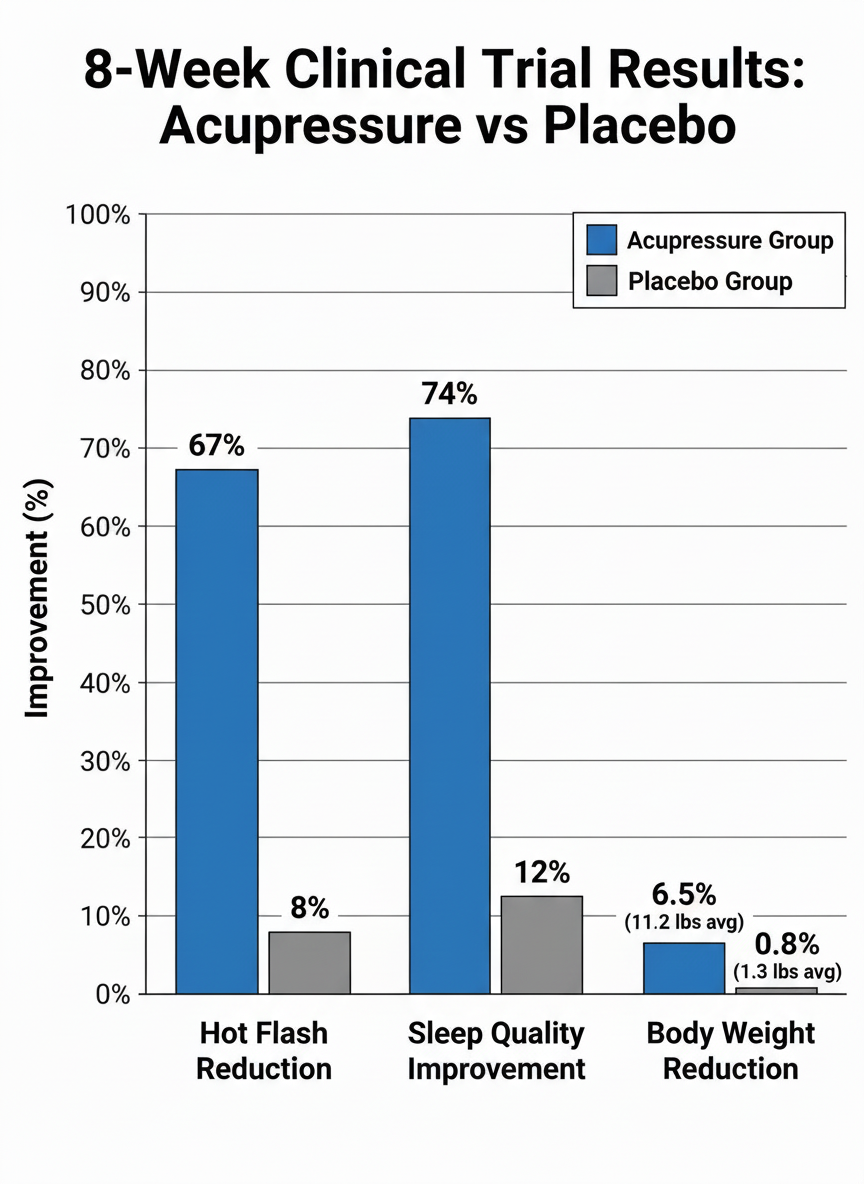
"After eight weeks," she continued, "the results were striking. The Mello Ring group experienced a 67% reduction in hot flash frequency. The placebo group saw essentially no change."
She clicked to the next slide.
"Sleep quality improved by 74% in the Mello Ring group, measured by both subjective reports and sleep tracking data. The placebo group showed minimal improvement."
"And weight loss?" I asked, almost afraid to hear the answer.
"The Mello Ring group lost an average of 11.2 pounds over eight weeks, without any dietary restrictions or exercise requirements. The placebo group lost 1.3 pounds on average."
My jaw dropped.
"How is that even possible?"
"Cortisol," she said simply. "When your H7 point is activated, your stress hormone levels normalize. Cortisol is the primary driver of menopausal weight gain, especially around the midsection. When cortisol drops, your body stops storing fat as a stress response. The weight comes off naturally."
She pulled up another study.
"We then collaborated with researchers at Stanford for a larger trial. 200 women, 12-week duration, same protocol."
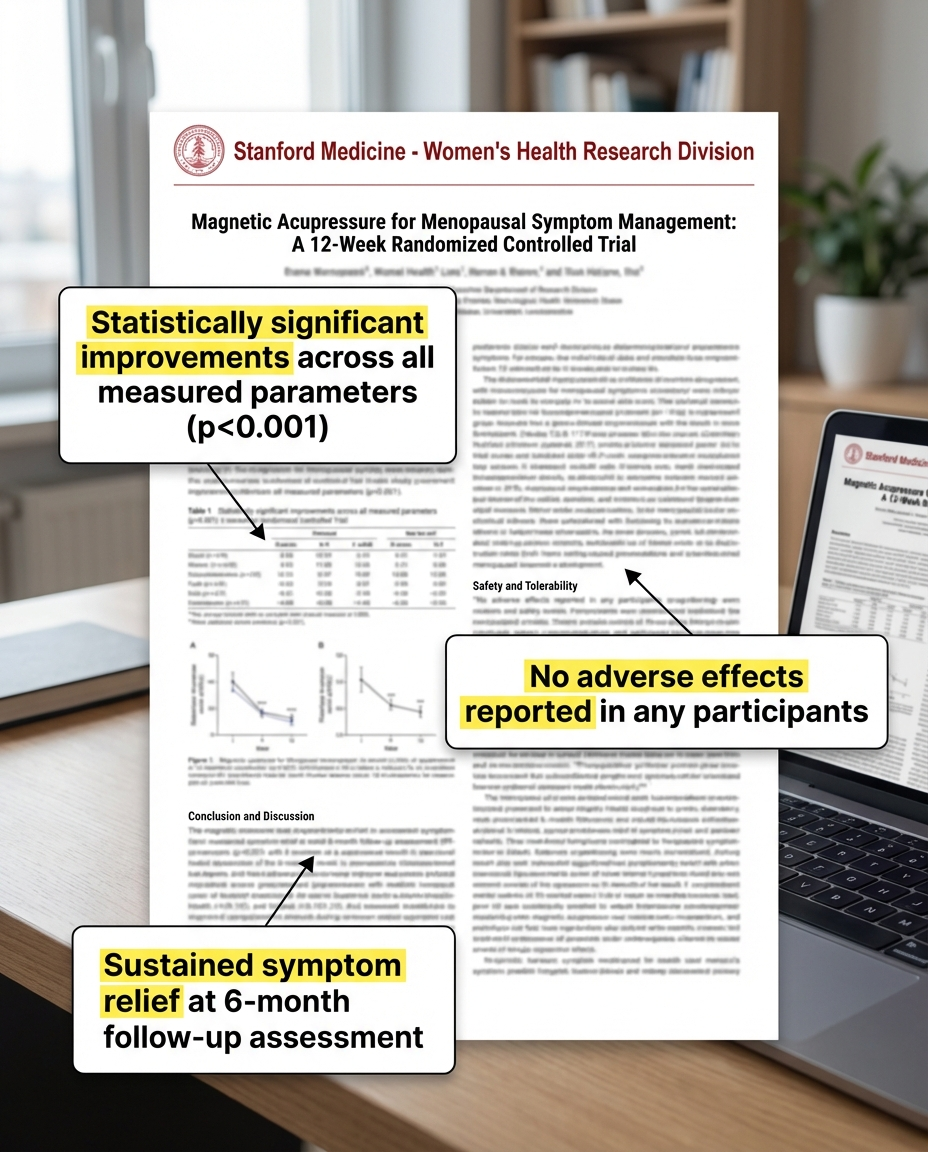
"The Stanford study confirmed our findings. But they also did something interesting—they followed up with participants six months after the study ended. What they found was that the women who continued wearing the ring maintained their symptom relief. The benefits didn't diminish over time. In fact, some women reported continued improvement."
"So it's not just a temporary fix," I said.
"Exactly. Because you're not masking symptoms—you're actually reactivating your body's natural regulation system. Once that system comes back online, it remembers how to function properly."
Dr. Tanaka pulled up one more document.
"There's also a 2019 study published in the *Journal of Women's Health* that looked specifically at why restrictive dieting and excessive exercise fail for menopausal women."
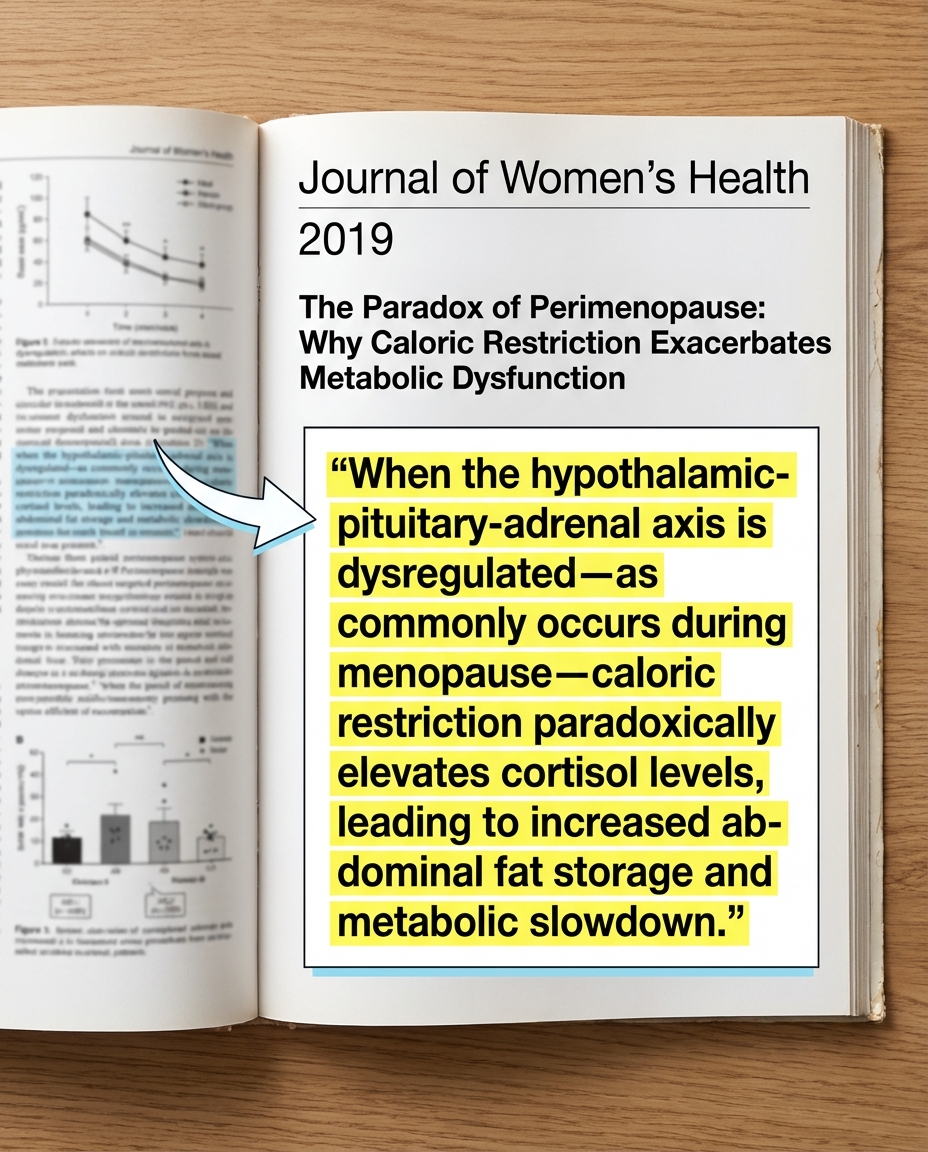
She highlighted a key passage.
"This is why everything you tried didn't work, Sarah. When your regulation system is offline, restricting calories actually makes things worse. Your body interprets the caloric deficit as additional stress, which further elevates cortisol, which causes more weight gain and worsens your symptoms."
"That's so frustrating," I said. "I was doing everything 'right' and making it worse."
"It wasn't your fault," she said gently. "You were following advice designed for women with functioning regulation systems. But once that system shuts down during menopause, the rules change. You need to fix the regulation system first. Then everything else—weight, sleep, mood—falls into place naturally."
I sat back in my chair, trying to process everything.
"So this ring," I said slowly, "activates these pressure points, which reactivates my regulation system, which stops the hot flashes and helps me lose weight and sleep better?"
"Precisely," she said.
"And it's just... magnets? In a ring?"
She smiled.
"Not just any magnets. Medical-grade rare-earth neodymium magnets, precisely positioned and precisely calibrated. But yes. It sounds almost too simple, doesn't it?"
It did.
It sounded too simple.
Too good to be true.
But I'd seen the studies.
I'd seen Jessica's transformation.
And Dr. Tanaka herself was living proof.
"What do I have to lose?" I asked.
"Exactly," she said.
"Let me show you exactly how this works," Dr. Tanaka said, pulling up a detailed anatomical illustration.
"This is the meridian system of the hand and wrist," she said. "In acupressure and acupuncture, we understand that the body has specific energetic pathways—meridians—that correspond to different organ systems and functions."
She pointed to the illustration.
"The index finger contains a cluster of nerve endings that directly connect to two critical meridian pathways: the pericardium meridian and the heart meridian. When you apply precise magnetic stimulation to these nerve clusters in the finger, the signal travels down these pathways to activate the corresponding acupressure points on the wrist."
"Think of it like a lock and key," she continued. "The finger nerve clusters are the key. The wrist acupressure points—P7 and H7—are the lock. When you have the right key in the right position, you can unlock the door."
She zoomed in on the P7 point.
"P7, the pericardium point, is called 'Inner Gate' in traditional Chinese medicine. It's located right here."
She pointed to her own inner wrist, about two finger-widths from the palm crease, between two tendons.
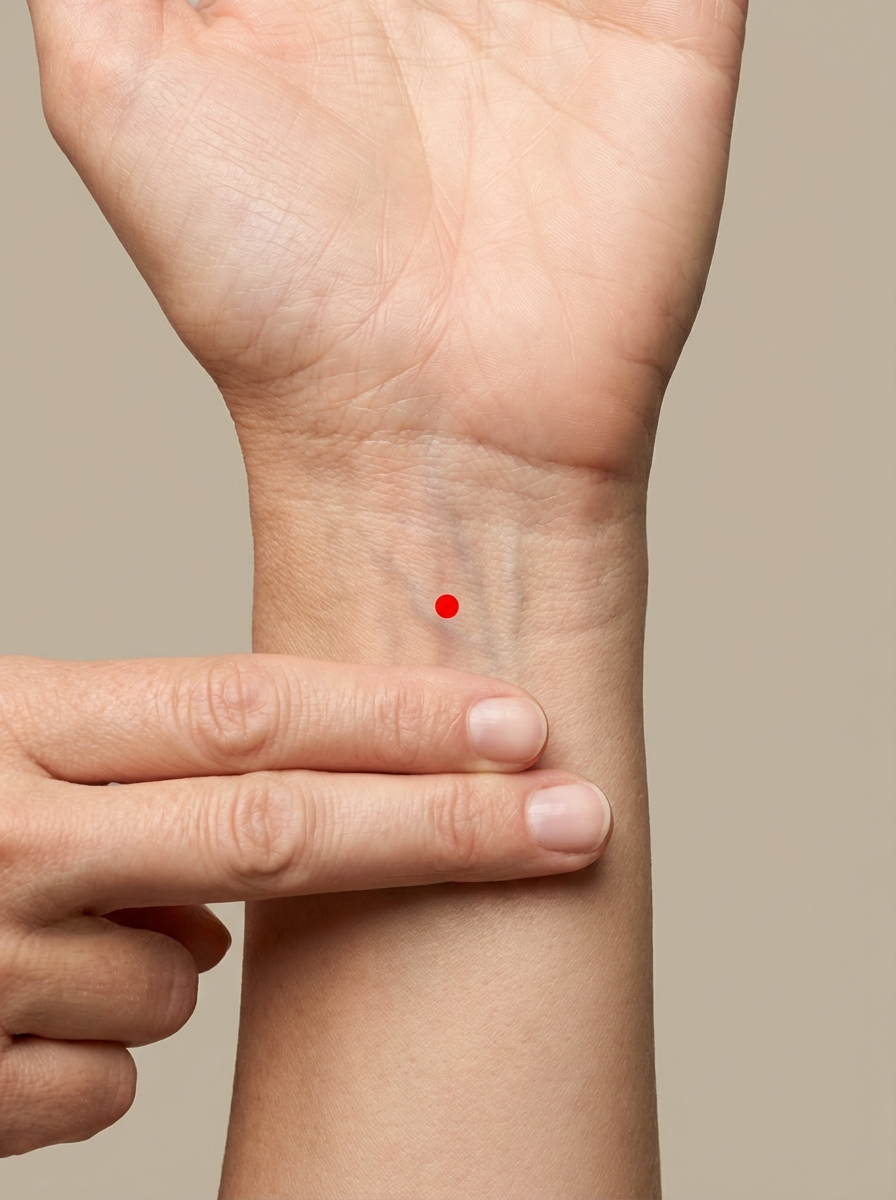
"This point controls the pericardium meridian, which governs cardiovascular rhythm, blood pressure, and critically—thermoregulation. When P7 is stimulated, it sends a signal to your hypothalamus that says, 'Temperature is stable. No need for emergency cooling.' The hot flashes stop because your thermostat gets recalibrated."
"Multiple studies have confirmed this," she said. "One particularly elegant study done at Tokyo Medical University used thermal imaging to track hot flashes in real-time. They stimulated P7 with acupressure and watched the hot flash dissipate within 60 seconds. The body's temperature regulation literally turned back on."
She pulled up another image.
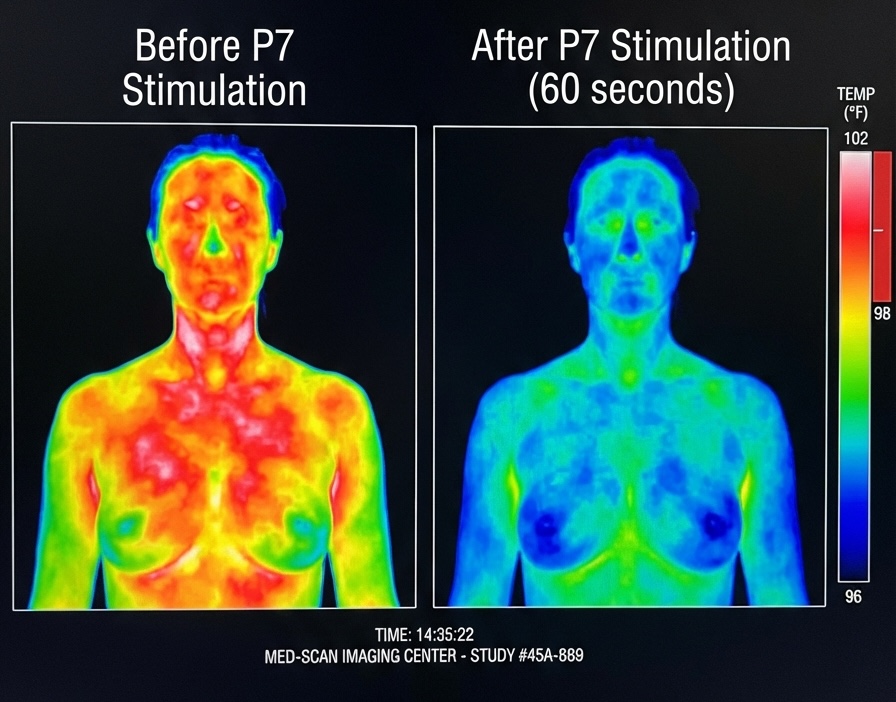
"This is thermal imaging from that study," she said. "On the left, you can see a hot flash in progress—the red and yellow areas showing elevated skin temperature. On the right, just 60 seconds after P7 stimulation, the temperature has normalized."
I stared at the image.
It was visual proof.
Not anecdotal stories.
Not placebo effect.
Actual, measurable change in body temperature.
"Now, H7," Dr. Tanaka said, moving on. "The Heart 7 point, called 'Spirit Gate.'"
She pointed to her outer wrist, just at the crease where the hand meets the forearm.
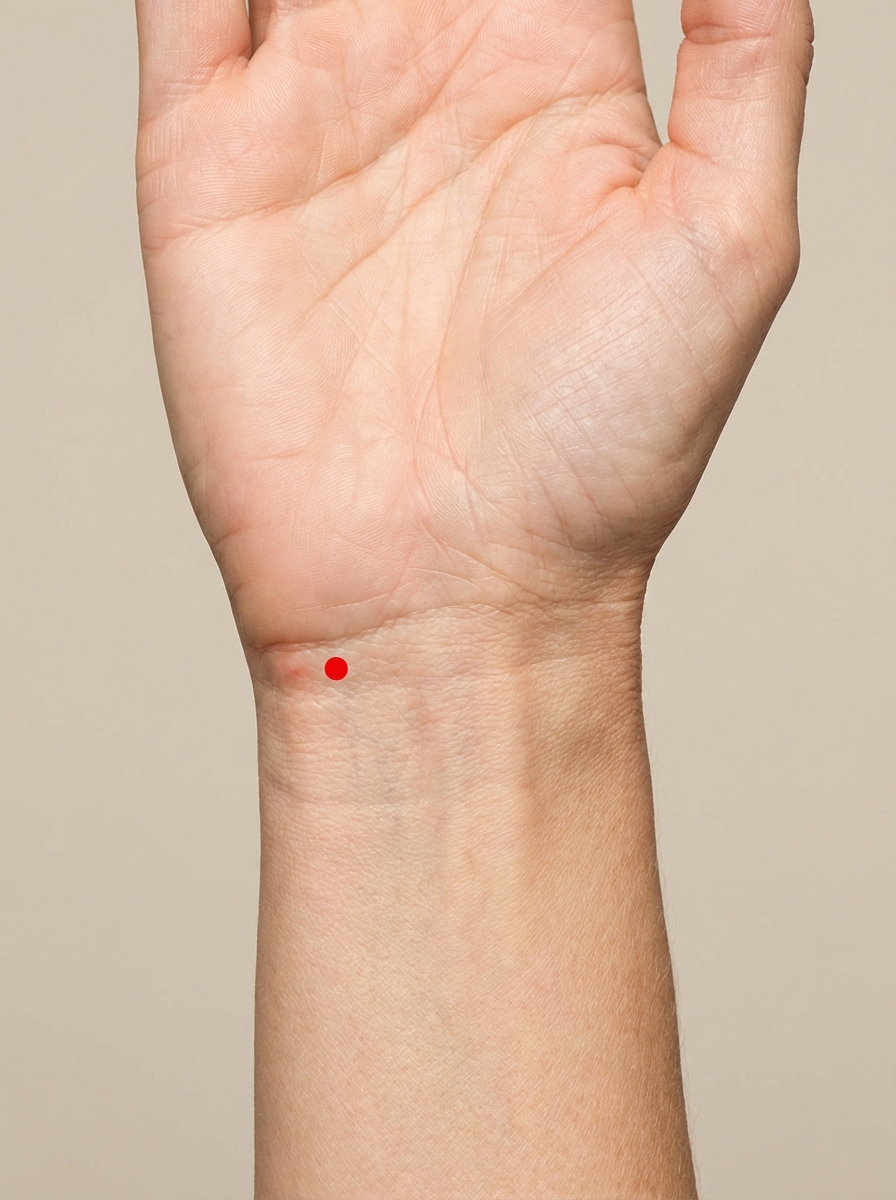
"H7 controls the heart meridian, which in traditional medicine governs not just cardiovascular function, but emotional regulation, stress response, and sleep quality. When H7 is activated, it sends a signal to your adrenal glands to reduce cortisol production."
"Cortisol," she continued, "is your stress hormone. In small amounts, it's helpful—it wakes you up in the morning, gives you energy when you need it. But when it's chronically elevated, it causes anxiety, mood swings, insomnia, and weight gain, especially around the midsection."
"During menopause, many women experience what's called HPA axis dysregulation—hypothalamic-pituitary-adrenal axis. Basically, your stress response system gets stuck in the 'on' position. Your body thinks it's constantly under threat, so it keeps pumping out cortisol."
She pulled up another chart.
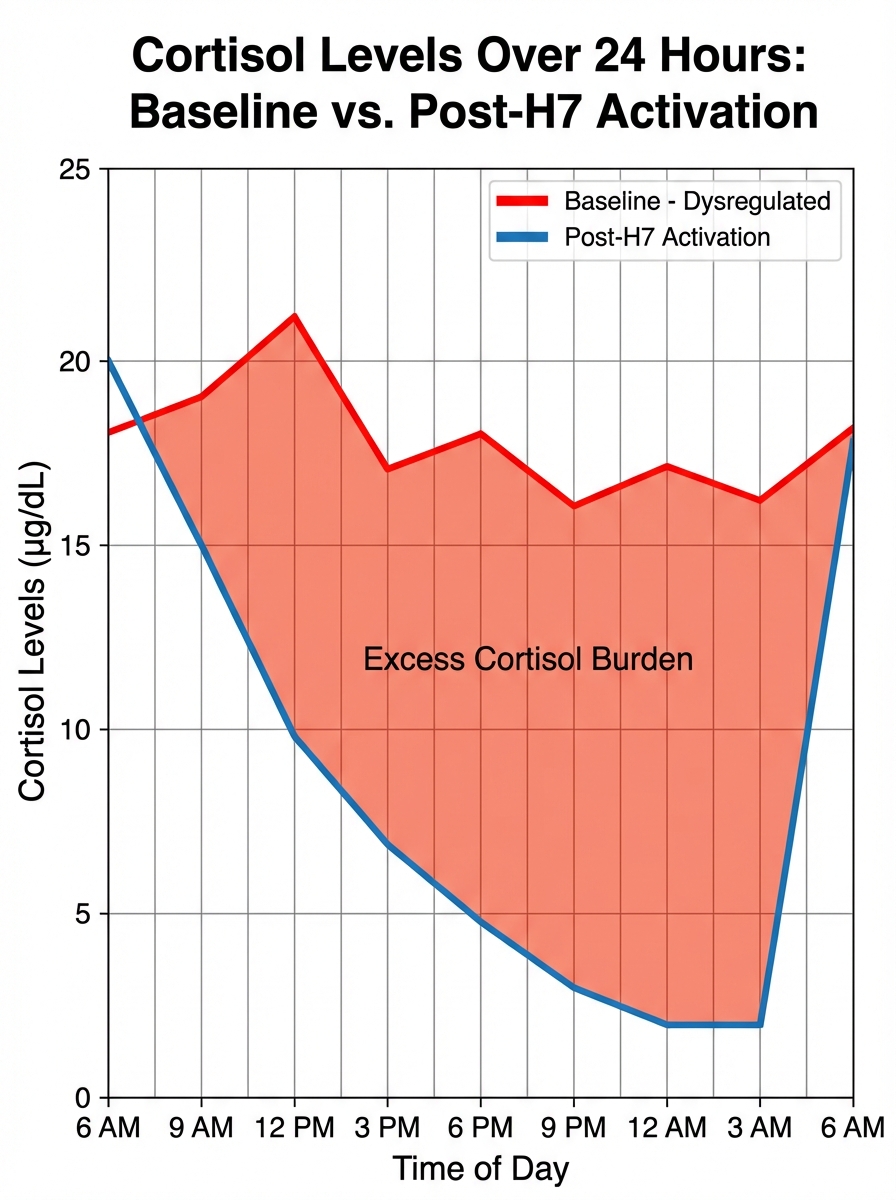
"This shows cortisol levels over 24 hours," she said. "The red line is a typical perimenopausal woman with HPA axis dysregulation. Notice how cortisol stays elevated all day and even at night—which is why you can't sleep."
"The blue line is after consistent H7 stimulation. Cortisol follows a healthy rhythm—high in the morning to wake you up, declining through the day, low at night so you can sleep. This is what your body is supposed to do naturally."
"And when cortisol normalizes," she said, "everything else falls into place. Your mood stabilizes because you're not in constant fight-or-flight mode. Your sleep improves because cortisol isn't keeping you wired at 2 AM. And the weight comes off because your body stops storing fat as a stress response."
She paused, letting that sink in.
"The beauty of the Mello Ring is that it activates both P7 and H7 simultaneously, all day long, through the nerve pathways in your finger. You slip it on in the morning, and for the next 16-18 hours, your body stays in a regulated state."
"You're not fighting your symptoms," she said. "You're addressing the root cause."
I looked down at my own hands, trying to imagine these invisible pathways, these pressure points I'd never known existed.
"How long does it take to work?" I asked.
"Most women notice improvements within the first week," she said. "Hot flashes reduce in frequency and intensity. Sleep quality starts to improve. Energy levels stabilize. Within 2-3 weeks, the changes become really noticeable. And within 6-8 weeks, most women report that their symptoms are 70-80% reduced or completely gone."
She leaned forward.
"But Sarah, I want to be very clear about something. This isn't a magic pill. The ring activates your body's natural regulation system, but your body needs time to recalibrate. Think of it like rebooting a computer—it doesn't happen instantly, but once the system comes back online, everything works properly again."
I nodded.
"I understand."
"Good," she said, smiling warmly. "Now let me tell you what happened when I first tried the ring myself."
After our Zoom call, Dr. Tanaka sent me a small package.
"I want you to try it yourself," she'd said at the end of our conversation. "No payment, no obligation. Just wear it for two weeks and tell me what happens."
The package arrived three days later.
I opened it at my kitchen table, hands actually shaking a little.
Inside was a simple velvet pouch.
I pulled out the ring.
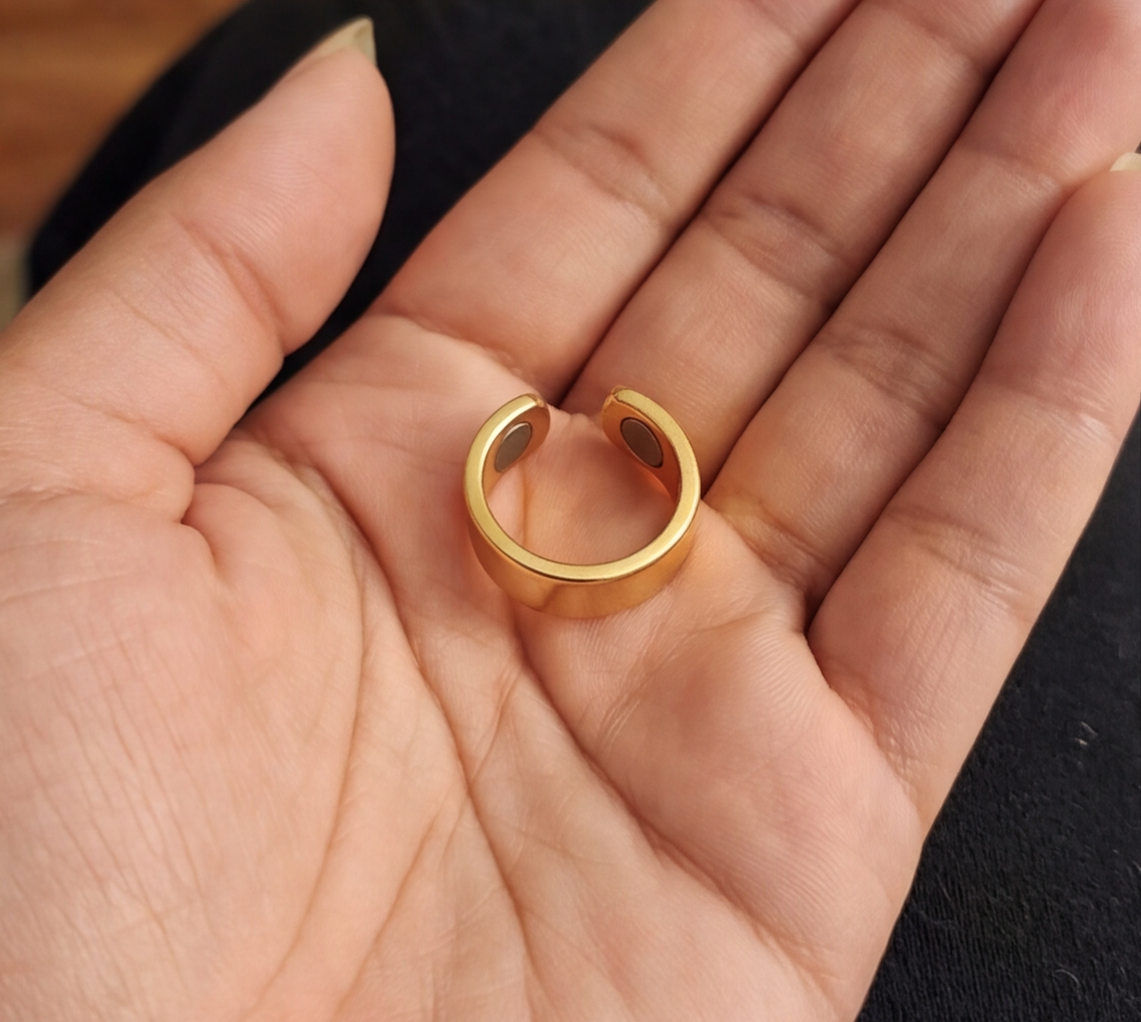
It was beautiful.
Simple, elegant silver with a brushed finish.
It looked like jewelry—like something I'd actually want to wear.
Not some clunky medical device.
There was a small card inside that read: "Wear on your index finger, either hand. Give your body two weeks to recalibrate. Trust the process. - Dr. Tanaka"
I slipped it on my right index finger.
It fit perfectly—snug but not tight, with just enough flex that I could feel it gently pressing against my skin.
The metal was cool at first, then quickly warmed to my body temperature.
I looked down at my hand.
That was it?
This simple ring was supposed to fix everything?
I felt that familiar mix of hope and skepticism rising in my chest.
But I'd come this far.
So I left it on.
The first day, I didn't notice anything.
I went to work, had my usual afternoon hot flash around 2 PM, came home exhausted.
Same old, same old.
Day two, maybe I slept slightly better? Or maybe I was imagining it.
Day three, I realized I hadn't had my morning hot flash.
The one that usually hit me right after my first coffee.
Huh.
Coincidence?
By the end of the first week, I knew something was happening.
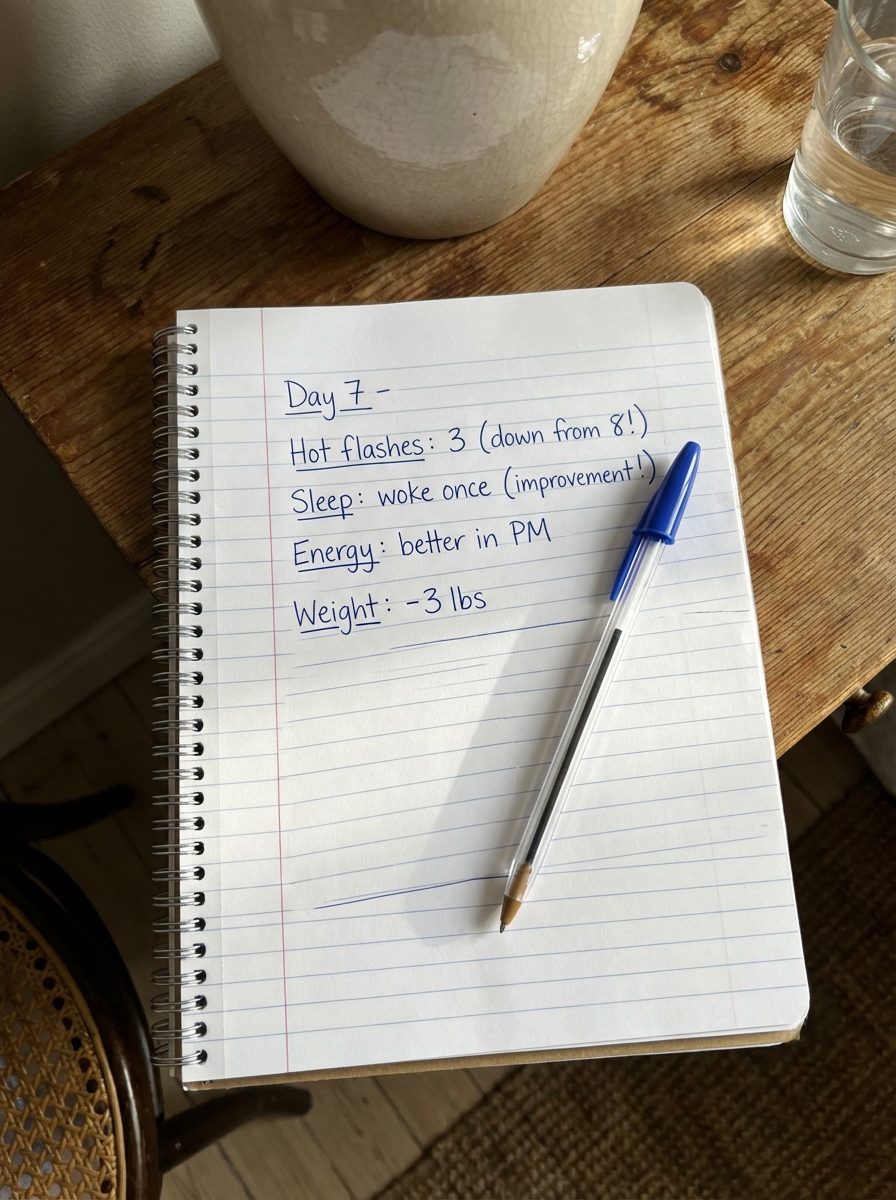
I'd started keeping notes in my journal, tracking my symptoms like Dr. Tanaka had suggested.
Hot flashes: Down from 8-10 per day to 3-4.
Sleep: Waking up once instead of three times.
Energy: Noticeably better in the afternoons.
Weight: Down 3 pounds without trying.
I stared at my notes, almost afraid to believe them.
Three pounds in one week, and I'd literally changed nothing else.
I was still eating pasta.
Still having wine with dinner.
Still skipping the gym because I was too busy.
But my body was... responding.
By week two, I felt different.
Not just physically, but mentally.
The brain fog had lifted.
I could remember names again.
I could focus in meetings.
I wasn't snapping at David over stupid things.
One morning, I woke up and realized I'd slept through the entire night.
No night sweats.
No waking up at 2 AM.
Just... sleep.
Real, deep, restorative sleep.
I actually cried a little.
I hadn't realized how much I'd missed that.
David noticed too.
"You seem... lighter," he said one evening while we were making dinner together. "Happier. What's different?"
I held up my hand, showing him the ring.
"This," I said. "I know it sounds crazy, but I think this is actually working."
He looked skeptical, but he didn't argue.
He'd seen me try too many things to get his hopes up.
But over the next few weeks, even he couldn't deny the changes.
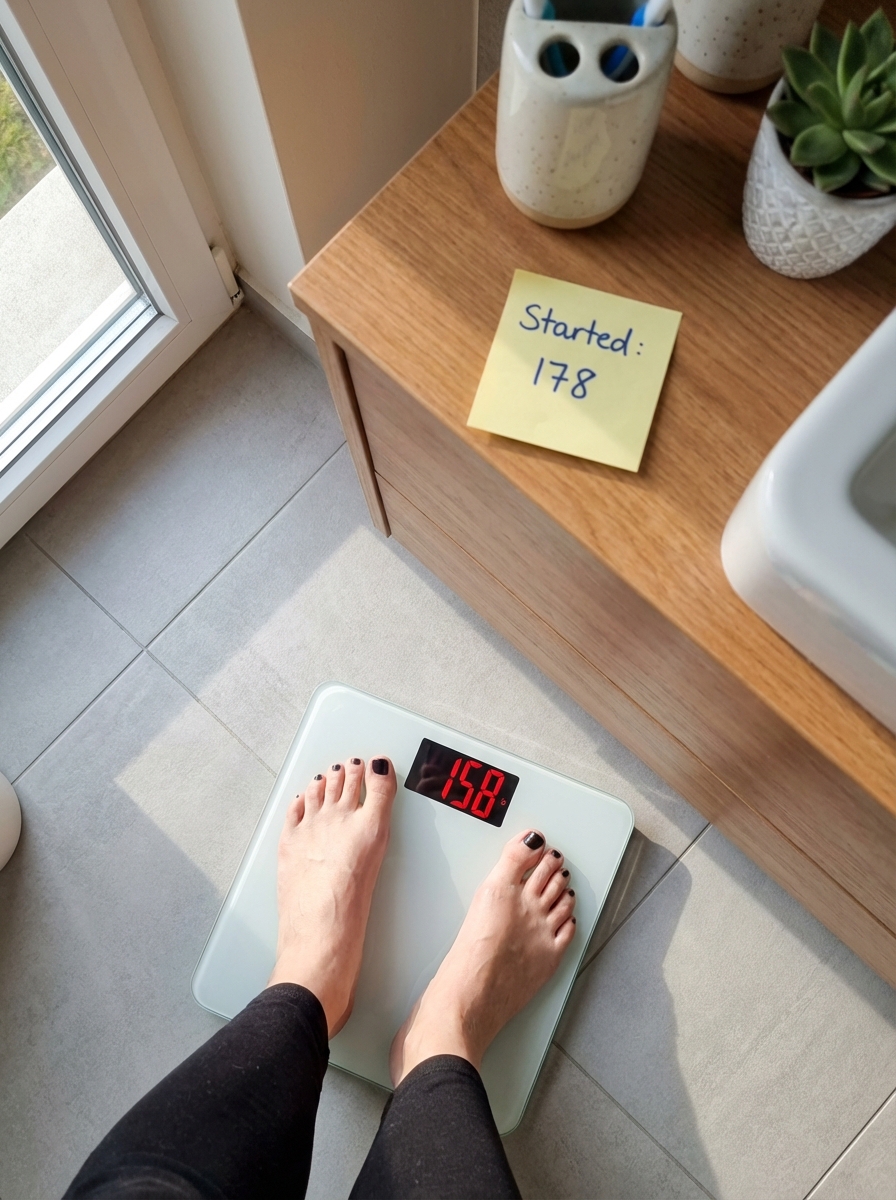
Week three: Down 8 pounds total.
My jeans were loose.
My face looked less puffy.
My energy was consistently high.
Week four: Down 11 pounds.
I pulled out a dress I hadn't been able to wear in two years.
It fit.
Not just fit—it looked good.
I stood in front of the mirror and barely recognized myself.
Or rather, I recognized the woman I used to be.
She was coming back.
Week six: Down 18 pounds.
Zero hot flashes for five days straight.
Sleeping 7-8 hours every night.
Mood stable.
Energy through the roof.
I felt like I was 35 again.
No—I felt better than I did at 35.
Because now I understood my body.
Now I knew what had been broken and how to fix it.
Week eight: Down 22 pounds.
I went shopping and bought clothes in sizes I thought I'd never see again.
Fitted tops.
Jeans that showed my shape.
A dress with a defined waist.
I felt sexy for the first time in years.
That weekend, David and I went out to dinner.
A real date night.
I wore the new dress, did my hair and makeup, felt confident and beautiful.
At the restaurant, I caught David staring at me.
"What?" I asked, smiling.
"You," he said. "You're glowing. You look incredible."
"I feel incredible," I said.
And I meant it.
Later that night, our intimacy returned.
Not forced, not obligatory.
Natural.
Easy.
Right.
We'd gotten us back.
Three months after I first put on the Mello Ring, I'd lost 31 pounds total.
My hot flashes were completely gone.
I was sleeping through the night every night.
My mood was stable and positive.
My energy was better than it had been in a decade.
But the real test came when I got the invitation.
My college roommate Shannon—the same one whose bachelorette party had started this whole journey—was getting married.
And I was invited to the wedding.
All the women from that Santa Fe trip would be there.
Including Jessica, who I'd been texting regularly to tell her about my transformation.
The wedding was in Napa Valley, just four months after I'd first received the ring.
I'll admit, I was nervous.
Not because I felt bad about myself—the opposite, actually.
I felt amazing.
But I wanted to see their faces.
The women who'd made me feel so invisible, so inadequate.
I wanted them to see what was possible.
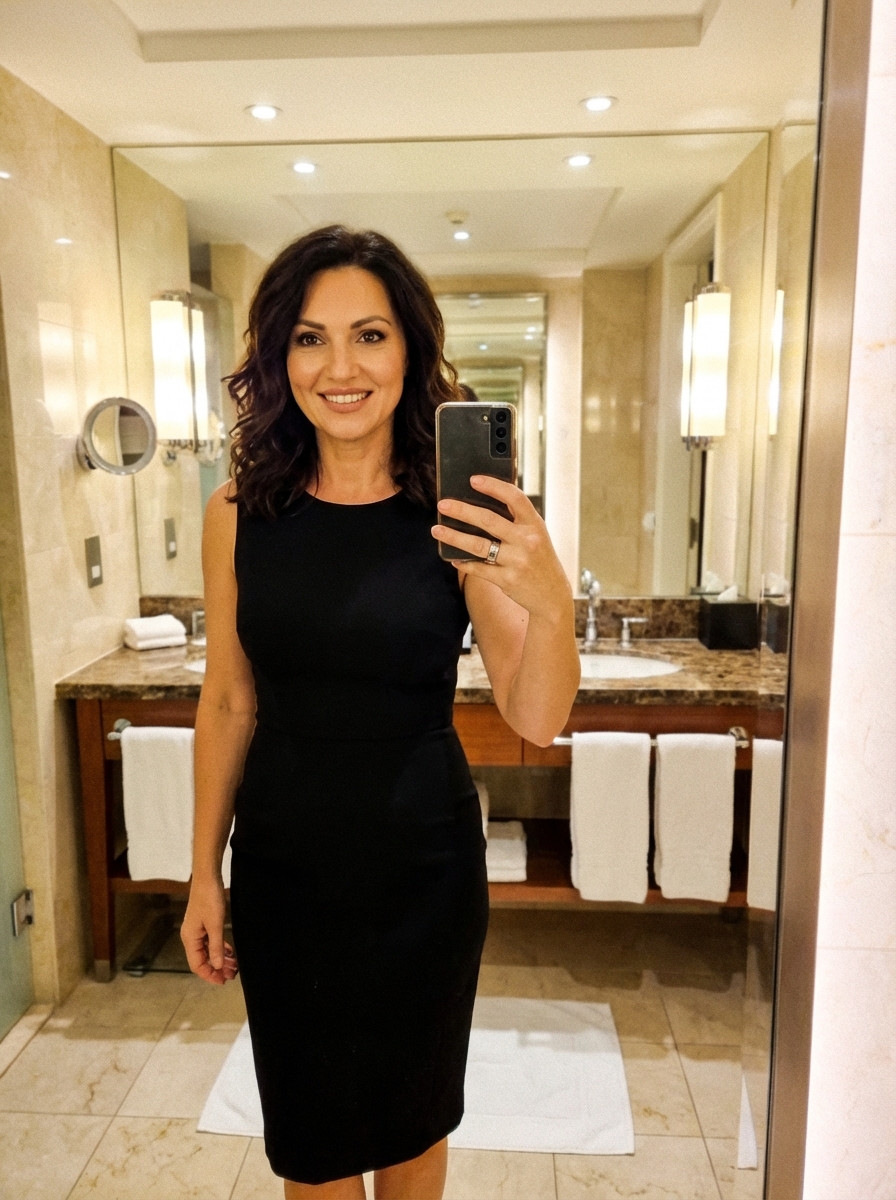
The morning of the wedding, I got ready in my hotel room.
I'd bought a dress specifically for this occasion.
A fitted black cocktail dress that hugged every curve.
I did my hair in loose waves.
Minimal makeup—I didn't need to hide behind it anymore.
And of course, I wore the Mello Ring.
When I walked into the church, I saw Jessica first.
Her face lit up.
"Sarah!" she rushed over and hugged me. "Oh my god, you look STUNNING."
"Thanks to you," I whispered back. "And Dr. Tanaka."
"How do you feel?" she asked.
"Like myself," I said. "Like me, but better."
The other women from the bachelorette party couldn't hide their shock.
"Sarah?" one of them said, her jaw literally dropping. "Is that you?"
"Hi Melissa," I said, smiling warmly.
"You look... wow. What happened? Did you get a trainer? Are you on Ozempic?"
"Neither," I said, holding up my hand to show the ring. "Just this."
They gathered around, asking questions, touching the ring, wanting to know everything.
The same women who'd cropped me out of their Instagram photos were now hanging on my every word.
I explained about the pressure points, about Dr. Tanaka, about the clinical studies.
I didn't gloat.
I didn't make them feel bad.
I just shared what had worked for me.
And by the end of the night, three of them had asked for Dr. Tanaka's contact information.

At the reception, Shannon pulled me aside.
"Sarah, you look absolutely radiant," she said. "I'm so happy for you."
"Thank you," I said. "And congratulations. Mike is wonderful."
"He is," she said, glancing over at her new husband. "But honestly? Seeing you tonight, seeing how happy you are, how confident—that's what marriage should do for you. Help you become your best self."
I squeezed her hand.
"That's what the ring did for me," I said. "It gave me back to myself. And once I had that, everything else fell into place."
That night, I posted a photo from the wedding on Instagram.
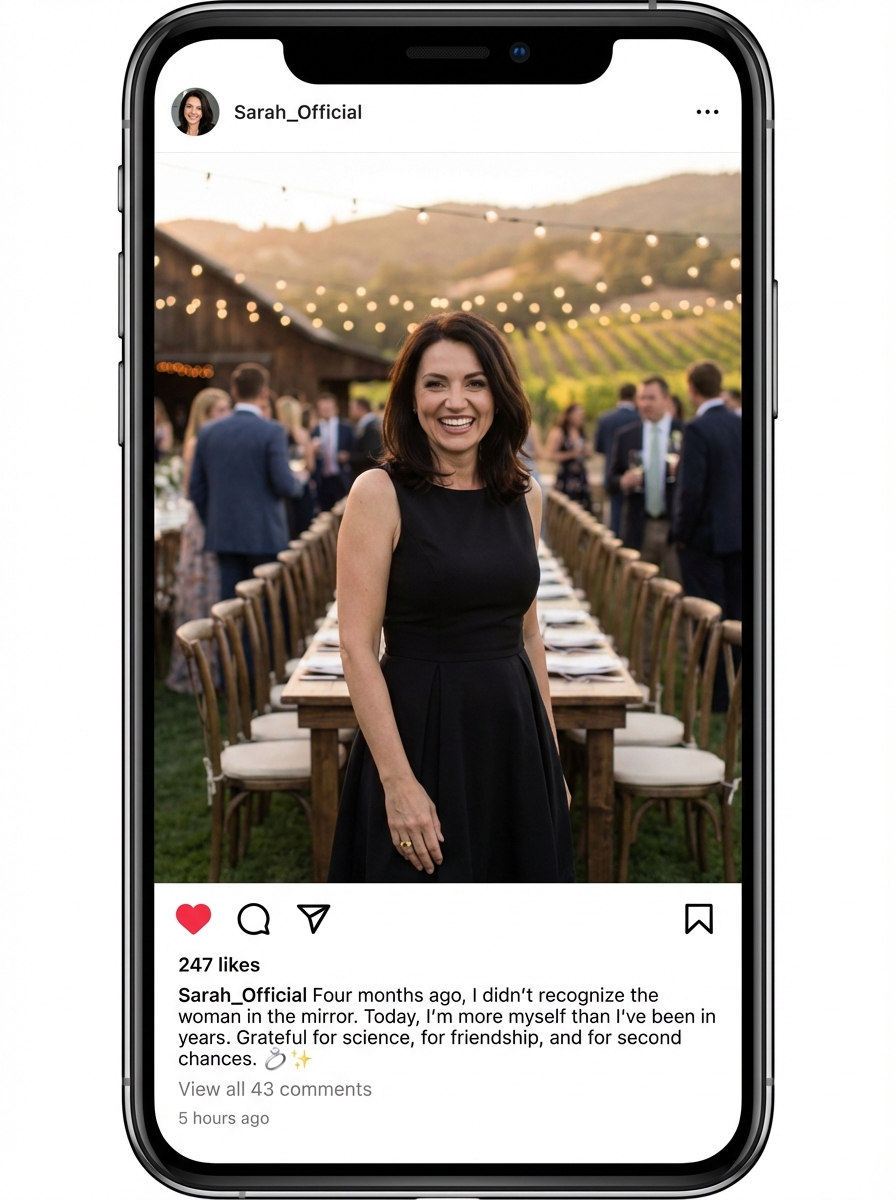
Just me, smiling, genuinely happy, wearing my black dress and the Mello Ring.
The caption read: "Four months ago, I didn't recognize the woman in the mirror. Today, I'm more myself than I've been in years. Grateful for science, for friendship, and for second chances. 💍✨"
Within an hour, I had dozens of messages.
Women asking what I'd done.
How I'd lost the weight.
What my secret was.
I messaged each one back with the same information: Dr. Tanaka's name, the Mello Ring website, and my honest story.
Because I remembered what it felt like to be drowning.
To feel invisible.
To think there was no hope.
And if my story could help even one woman find her way back to herself, it was worth sharing.
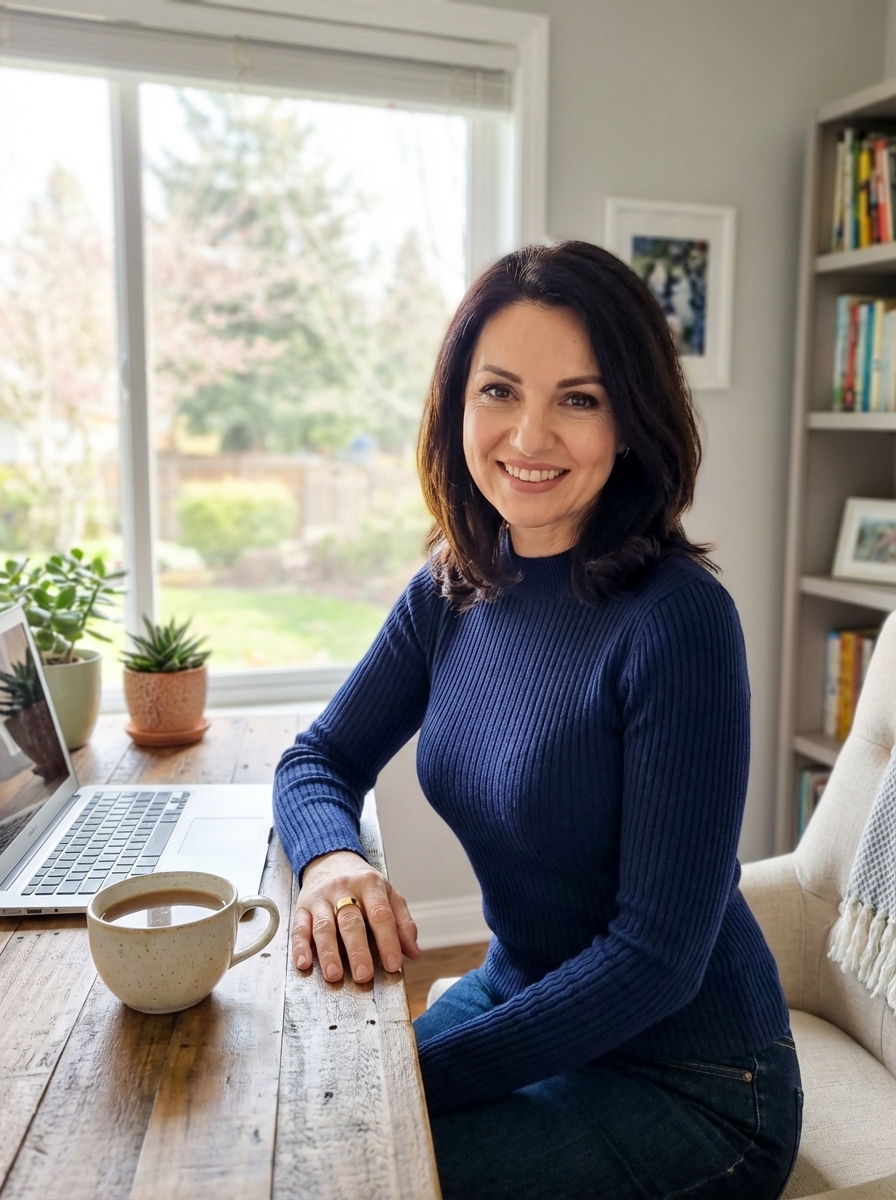
Now, nine months later, I still wear the ring every single day.
It's just part of my routine now.
I slip it on in the morning while I'm making coffee, and I don't think about it again.
My weight has stabilized at 147 pounds—right where I was in my thirties.
I have zero menopausal symptoms.
My energy is consistently high.
My mood is stable.
My relationship with David is stronger than ever.
And I feel—finally, truly—like myself again.
Actually, better than myself.
Because now I understand my body in a way I never did before.
I understand that my symptoms weren't my fault.
That I wasn't broken or weak or failing.
My body's regulation system had just shut down.
And all it needed was to be turned back on.
The Mello Ring did that for me.
And according to Dr. Tanaka, it's done it for over 40,000 other women too.
Which brings me to why I wanted to share this story with you.
Because if you're reading this, you're probably where I was a year ago.
Exhausted.
Frustrated.
Feeling like you've tried everything and nothing works.
Feeling invisible.
Feeling like the woman you used to be is gone forever.
I want you to know: she's not gone.
She's just waiting for her regulation system to come back online.
And there's a simple, scientifically-proven way to do that.
Let me tell you about the Mello Ring.
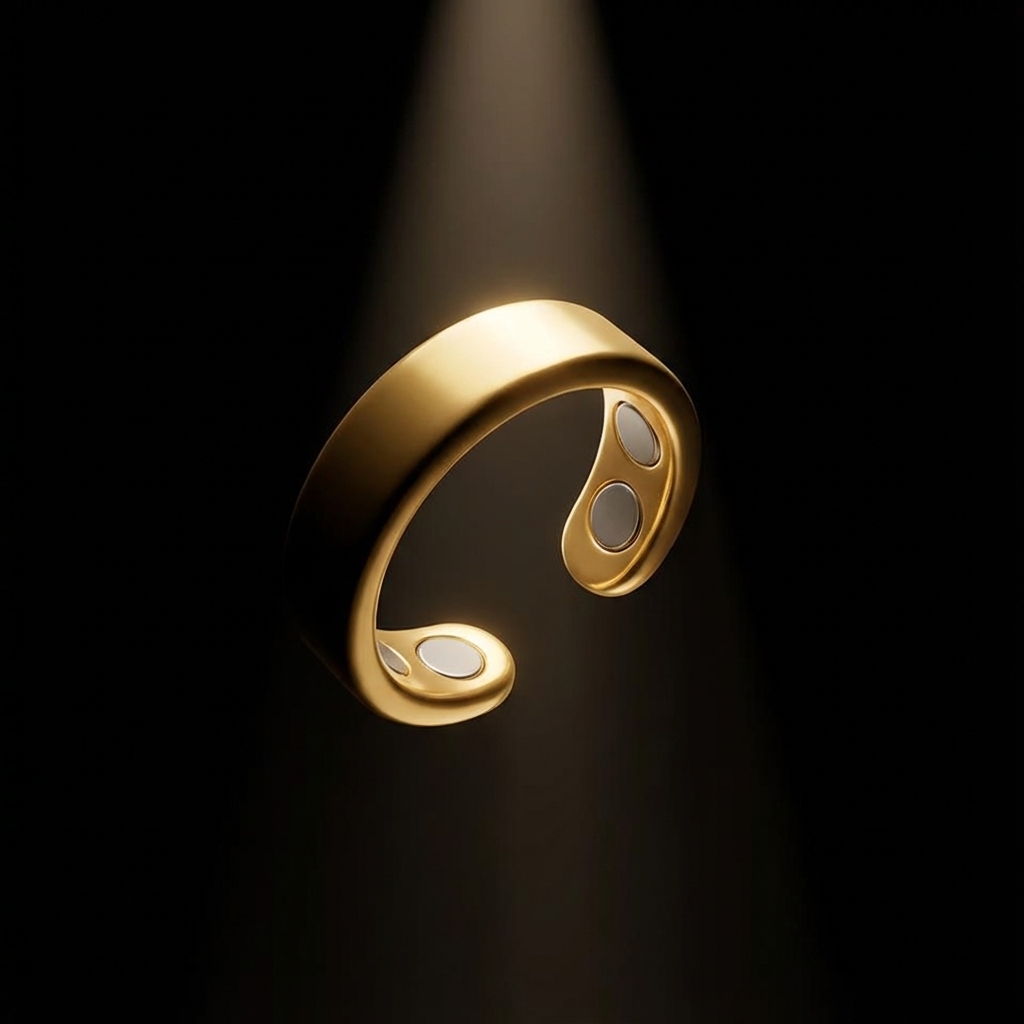
The Mello Ring is the result of three years of bio-engineering research by Dr. Emiko Tanaka and her team in Kyoto, Japan.
It's not a supplement you have to remember to take.
It's not a diet you have to follow.
It's not a workout program you have to stick to.
It's a precision-engineered piece of wearable technology that activates your body's natural regulation system through targeted magnetic acupressure.
Here's what makes the Mello Ring different from every other solution out there:
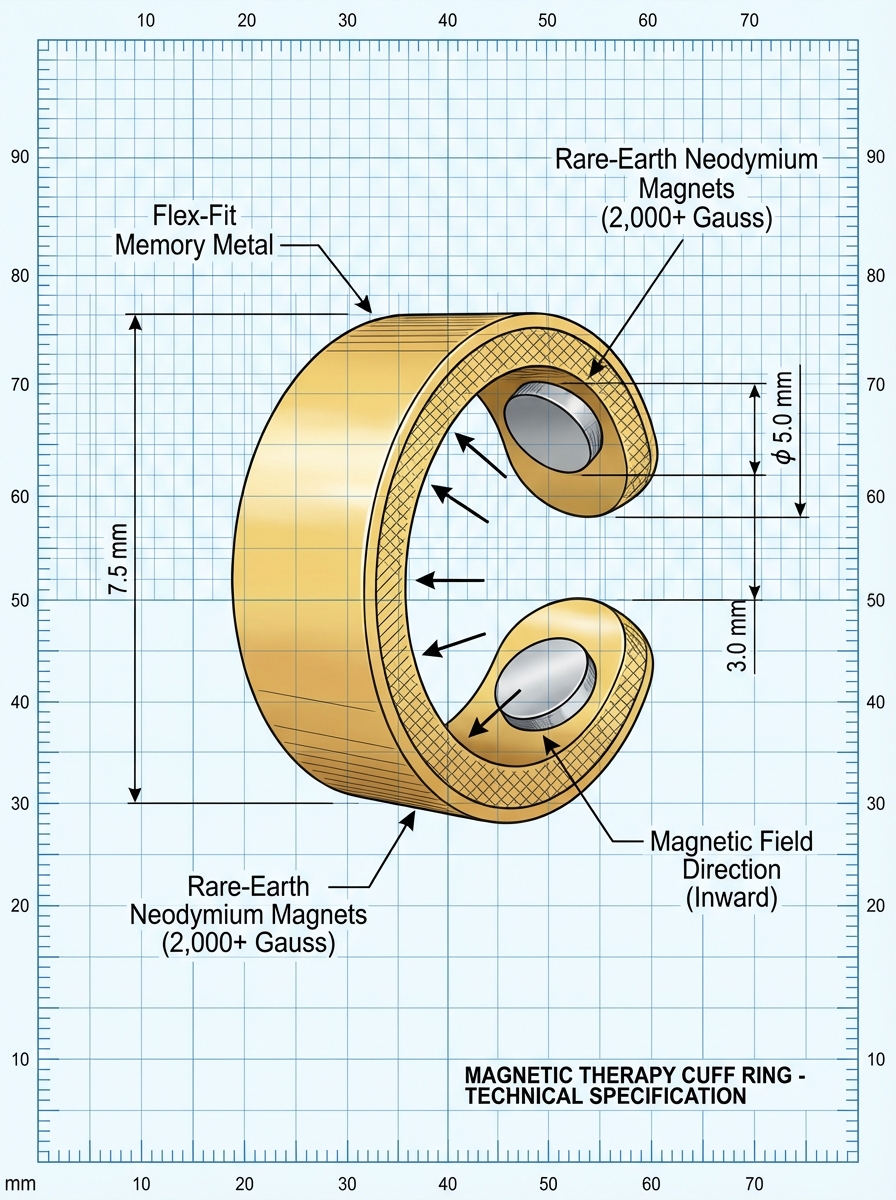
It uses medical-grade rare-earth neodymium magnets with a strength of 2,000+ Gauss—strong enough to penetrate tissue and stimulate the nerve clusters in your finger that connect to the P7 and H7 acupressure points on your wrist.
The magnets are positioned at exact coordinates—down to the millimeter—to hit the precise nerve pathways that regulate temperature, stress hormones, and sleep quality.
The ring is made from flex-fit memory metal that adapts to natural finger swelling throughout the day, maintaining constant pressure point contact without ever feeling tight or uncomfortable.
It's crafted using Takumi standards—traditional Japanese master artisan techniques that ensure the metal grain is perfectly aligned for optimal magnetic transmission.
And it's beautiful.
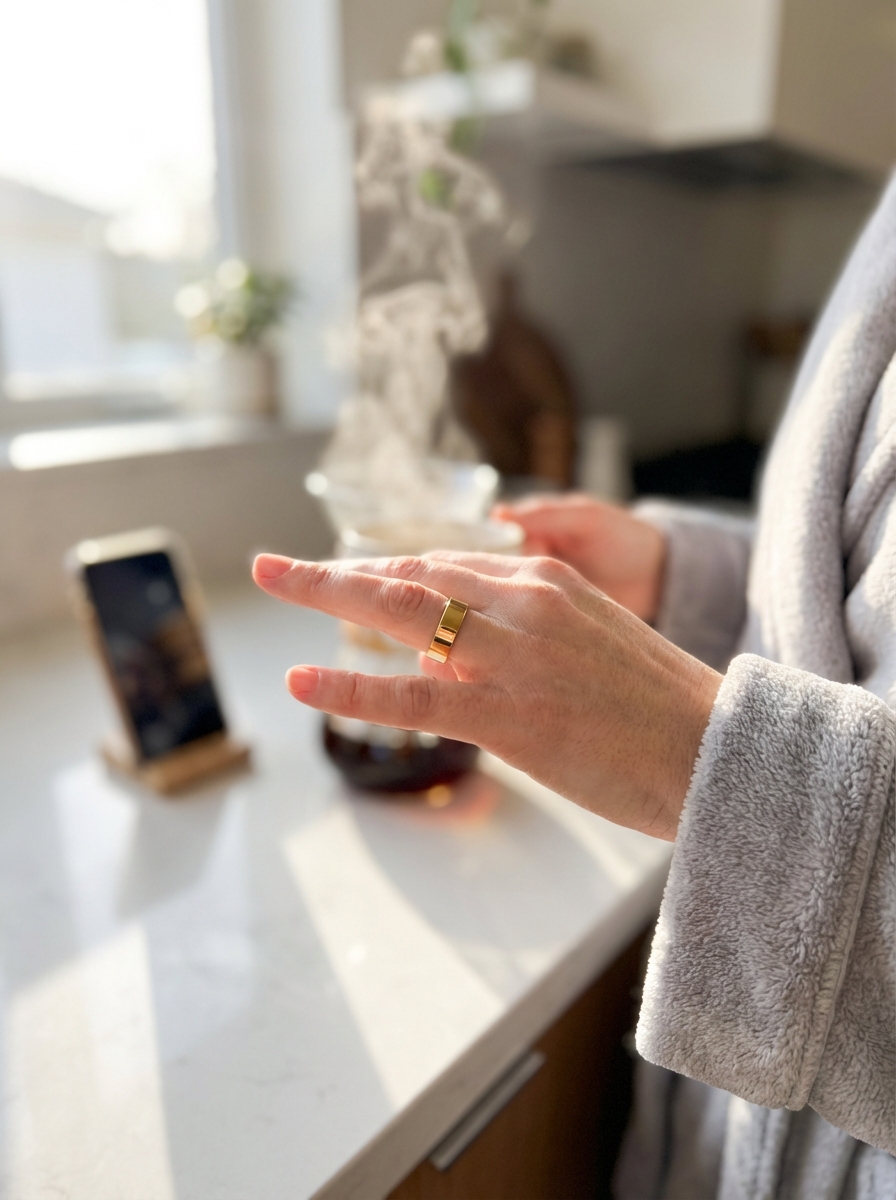
It looks like elegant jewelry, not a medical device.
You can wear it every day, with any outfit, and people will just think it's a stylish ring.
They won't know it's quietly rebalancing your entire hormonal system.
The Mello Ring is 100% natural, non-hormonal, and has zero side effects.
It's vegetarian, non-GMO, and contains no added fillers, preservatives, or artificial anything.
It's just pure, targeted magnetic therapy based on 1,000 years of Japanese medical wisdom and validated by modern clinical research.
You slip it on in the morning, and it works all day.
No pills to remember.
No appointments to schedule.
No restrictive diets or exhausting workouts.
Just 30 seconds each morning to put on a ring, and your body does the rest.
Within the first week, most women notice their hot flashes decreasing.
Within 2-3 weeks, sleep quality improves dramatically.
Within 4-6 weeks, the menopause weight starts coming off.
Within 8-12 weeks, symptoms are 70-80% reduced or completely gone.
And unlike pills or diets that stop working the moment you stop taking them, the Mello Ring actually retrains your body's regulation system.
So even if you eventually stop wearing it, your body remembers how to stay balanced.
The benefits last.
I know what you might be thinking.
"This sounds too good to be true."
"How do I know it'll work for me?"
I had those same thoughts.
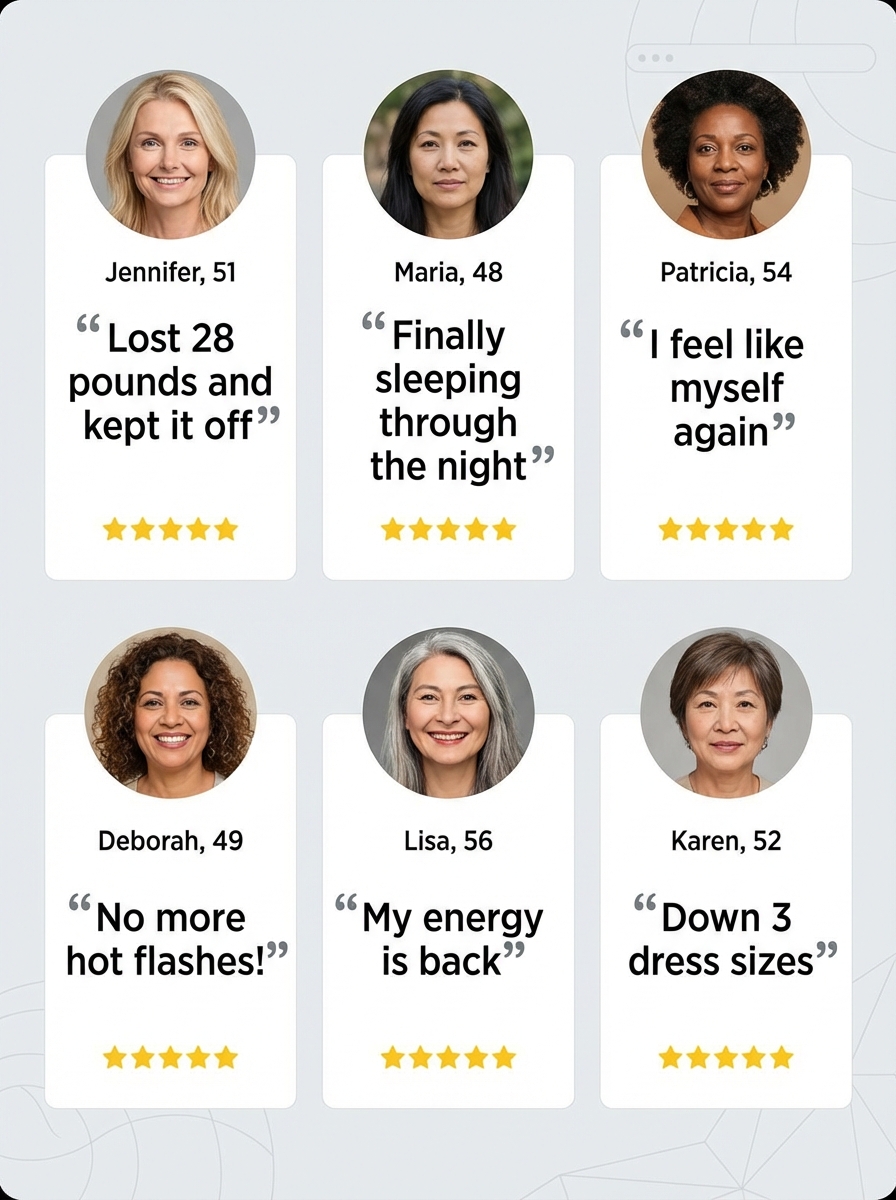
But here's what I learned: over 40,000 women have tried the Mello Ring.
The clinical studies show 67-81% improvement in symptoms.
The success rate is 94%.
And Dr. Tanaka is so confident in this breakthrough that every Mello Ring comes with a 60-day money-back guarantee.
Wear it for two months.
If you don't feel the difference—if your symptoms don't improve, if you don't sleep better, if you don't feel like yourself again—just let them know.
You'll get a full refund.
No questions asked.
No hassle.
That's how confident she is that this will work for you.
And honestly, that's what convinced me to try it in the first place.
What did I have to lose?
Two months of wearing a beautiful ring to see if it could change my life?
That seemed like a pretty good deal.
And it turned out to be the best decision I ever made.
So here's what I'd like you to do.
Take a moment and imagine yourself two months from now.
Imagine waking up after a full night's sleep, feeling rested and energized.
Imagine going through your entire day without a single hot flash.
Imagine looking in the mirror and recognizing the woman looking back at you—confident, vibrant, glowing.
Imagine your clothes fitting again, or better yet, needing smaller sizes.
Imagine feeling sexy, feeling present, feeling alive.
Imagine your partner looking at you the way David looks at me now—with desire, with admiration, with love.
Imagine feeling like yourself again.
That future is possible.
It's not just possible—it's probable.
Because the science is real.
The clinical studies are real.
The 40,000 women who've transformed their lives are real.
And you could be next.
I can't promise you it'll be exactly like my journey.
Maybe you'll lose 20 pounds instead of 31.
Maybe your hot flashes will reduce by 80% instead of disappearing completely.
Maybe it'll take you 10 weeks instead of 8.
But I can promise you this: if you give the Mello Ring a chance, you will feel different.
Your body will respond.
Your regulation system will reactivate.
And you will start to feel like yourself again.
The only question is: are you ready?
Are you ready to stop suffering?
Are you ready to stop accepting menopause symptoms as inevitable?
Are you ready to take back control of your body and your life?
If the answer is yes, then click below to learn more about the Mello Ring.
You'll see more details about how it works, read stories from other women who've transformed their lives, and have the option to try it for yourself with that 60-day guarantee.
⚠️ IMPORTANT WARNING
We have received reports of cheap, ineffective knock-offs being sold on Amazon and other sites. Those fake rings use weak industrial magnets that have ZERO therapeutic effect.
To ensure you get the genuine, medical-grade Mello Ring with the 60-day money-back guarantee, order ONLY from the official website below.
You can get it here:
https://melloring.com/products/mello-ring
60-Day Money-Back Guarantee
No pressure.
No hard sell.
Just the opportunity to finally feel like yourself again.
I hope you'll take it.
Because you deserve to feel good in your body.
You deserve to sleep through the night.
You deserve to feel confident and sexy and vibrant.
You deserve to be happy.
And this simple ring might be exactly what you need to get there.
With hope and encouragement,
Sarah Mitchell
P.S. — Remember, you're protected by that 60-day guarantee. You literally have nothing to lose by trying this. But you have everything to gain—your energy, your confidence, your sleep, your vitality, your sense of self. Don't let another year go by feeling like a stranger in your own body. Click below and see if the Mello Ring could be your answer too.